Authored by: Aisha Adil
Introduction
Since ancient times, the Vedic scriptures and religious texts have cherished women with deep respect and admiration. Hinduism frequently portrayed women as symbols of virtue, strength, and wisdom. The Rigveda, an ancient religious text, praises the significant role of women in both the family and society. It acknowledges their contributions not only as caregivers, but also as intellectuals and fighters. In the Qur’an, Islam grants women significant rights and status in both the spiritual and social spheres. The Qur’an granted women the right to education, property rights, and participation in public life.
But with time, several elements contributed to women’s standing declining. Women’s duties grew increasingly confined to the home as feudalism developed and patriarchal standards were established. Long deprived of their autonomy and independence, unfair practices such child marriage and dowry have for decades tormented women. Official statistics have revealed throughout time diminishing sex ratios, poor health and literacy rates, reduced work engagement, and negligible political involvement among women. Serious crimes such rape, molestation, and domestic abuse have shockingly been rising in frequency, which has had a significant effect on society.
Representing a horrific act of violence and violation, rape is a crime absolutely horrible against women. “Rape is not just a crime against women, but a crime against society as a whole,” said a Karnataka high court judge ruling on a gang rape case also continues that “Physical scar will heal up but mental scar will remain forever” This statement emphasizes the significant and enduring effects of rape on survivors, underscoring that the trauma goes beyond the physical and causes profound emotional and psychological wounds.
In response to the increasing number of brutal incidents, countries worldwide have implemented various measures to ensure the safety of women. These measures range from enacting laws that allow for capital punishment to allocating resources for the education of girls. The Indian government has implemented comprehensive measures to safeguard women who require assistance. However, in recent times, there has been a rise in false rape accusations, which is a concerning issue. Though not frequent, but these baseless accusations can have major impacts. Apart from undermining the credibility of actual victims, they also inflict long-lasting damage on the accused, hence fostering prejudice, damage of reputation, and psychological suffering. The sheer volume of cases still strains the court system greatly, which causes public mistrust of the judicial system to develop. False allegations of sexual assault present a grave danger to the credibility of the legal system and the ongoing battle against sexual violence. It is imperative to confront and minimize the repercussions of such cases. This paper will delve into the consequences of fraudulent legal cases.
- After a significant increase in legislation for women’s safety, we came to two major questions.
- What are the underlying reasons for making false allegations of rape?
- What is the impact of false rape allegations on the court system, the accused individuals, and genuine victims?
There Are Main Types Of False Allegation Cases
As per psychological and legal data-
- False allegations arise from false memories.
- False allegation cases arise when a person makes intentionally inaccurate accusations.
- False memories of rape and sexual assault
From time to time, a person truly believes that he or she was the victim of sexual assault based on what psychologists refer to as “false memories.”
The human brain is complex. Indeed, entire disciplines exist to study the brain and its mechanics. People generally consider memories to be a trustworthy account of actual, factual events. But in reality, there are many instances in which the brain creates false memories, according to Psychology Today.
Such a memory can feel so “real” to a person that it convinces them into believing that it is a factual recollection of an experienced event. A false memory is the erroneous memory of a rape or sexual assault that didn’t actually occur.
Young children influenced by adults to believe they were sexually attacked make most false memory claims. Children’s minds are still developing; hence they could be more sensitive and open to erroneous memory implantation.
- Purposefully false reporting of claims of rape and sexual assault
Most false allegation cases involve someone purposefully lying about having been raped or sexually assaulted. They not only make false claims of victimization, but they may also proceed to file a police report. This false report can then progress further to the criminal prosecution of an innocent person in a sexual assault or rape case.
Though unthinkable, there exist a myriad of reasons why a person might falsely report a rape or sexual assault. Some of the more common ulterior motives we encounter are:
- Revenge
- Material (monetary) gain
- To create an alibi
- To express regret
- To generate sympathy
- To draw attention
- To express anger
- Deny a consensual sexual encounter
- Mental instability
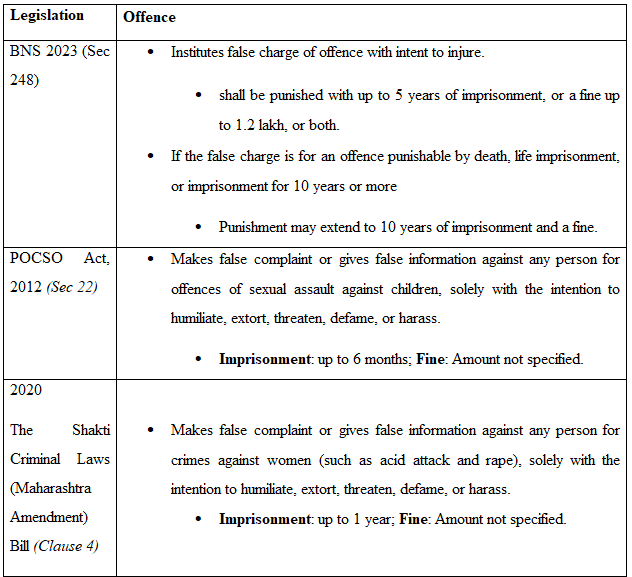
A person can face criminal charges if they file a police report with an intentionally false accusation of rape or sexual assault as mention below:
The Effect Of False Rape Charges On The Legal System, The Accused, And Actual Victims
● Psychological influence:
A false accusation of rape is a significant issue for an individual wrongly accused, as it persists and significantly disrupts their life. It profoundly affects the accused’s mindset; hence, he cannot heal from such shock and anguish. Mentally sick people isolate themselves and engage in self-hatred. This condition affects not only the charged person but also, if any, the spouse, family members, and close relatives. It could also have a negative effect on society at large
● Deaths from suicides:
Sometimes people commit horrible deeds like self-harm or suicide. Those who believe they cannot survive in society choose to die so that their families can live with dignity in their absence. Whereas some commit suicide because they fear spending a protracted period of time behind bars. In one instance, a manager took his own life. On August 30, Amit Kumar took his own life after a woman accused him of sexual harassment. He left a 5-page suicide note declaring great embarrassment by his firm, Optum Global Solution, over claims of sexual harassment, which he claimed were untrue.
● Loss of respect and honor:
False claims can harm the accused’s social status and lead to slander. It also causes suffering and disgrace; even after the court’s acquittal, others regard them as lacking character. In rape cases, both the accused and the woman making the claim lose their dignity. In Jagmohini v. State (NCT of Delhi) (2013), the victim alleges an attempt at carnal intercourse without respect for her own honor and dignity, as well as a false rape charge.
● Unnecessary imprisonment:
When someone accuses someone of rape, the police immediately arrest the accused because it is a serious crime. However, being arrested in a false accusation of rape would result in illegal imprisonment, or more precisely, a person is imprisoned unnecessarily.
● Violation of Justice:
Every sphere of justice administration should be guided by the natural justice concept. False and fraudulent accusations and convictions would be more than a distortion of justice.
● Legislative intent Violation:
The legislature creates laws that benefit the people and apply justice appropriately, allowing for the punishment of offenders and the reimbursement of victims. Legislative purpose is always to punish the rapist in cases of rape; yet, it is always against legislative intent when the allegation of rape is made falsely against an innocent person who is not entitled to be punished for an offence he did not commit.
Conclusion
The National Crime Record Bureau (NCRB) claims that under Section 376 of the Indian Penal Code, over 74% of rape trials end in acquittal of the accused. DGP of Rajasthan Mr. Umesh Mishra has said that 45% of bogus rape complaints registered in the state last year. It is thus true that a range of evidence shows how women are manipulating males nowadays using this weapon. About two years ago, a movement known as “MEE TOO” started whereby different women blamed different men. Unquestionably, a false rape allegation will cause psychological harm to the one so wrongly accused. False allegations can bring society stigma, affect family life, cause financial loss, and generally disturb personal and professional life.
The mens rea of the act must be demonstrated; simply because the claim is untrue does not make it false. Should it prove that the individual they are accusing of rape did not actually rape them, they are not guilty of falsely or misinformed accusation. This could develop in cases of mistaken identification or in situations where the individual reporting honestly thought they had not approved of the sexual contact. Approach these circumstances sensitively and with empathy since false charges can have major repercussions for all the people engaged. By means of legal guidance and support, one can negotiate the complexity of such situations and guarantee justice is rendered.
Jagmohini vs State (Gnct Of Delhi) & Ors. on 6 August, 2013