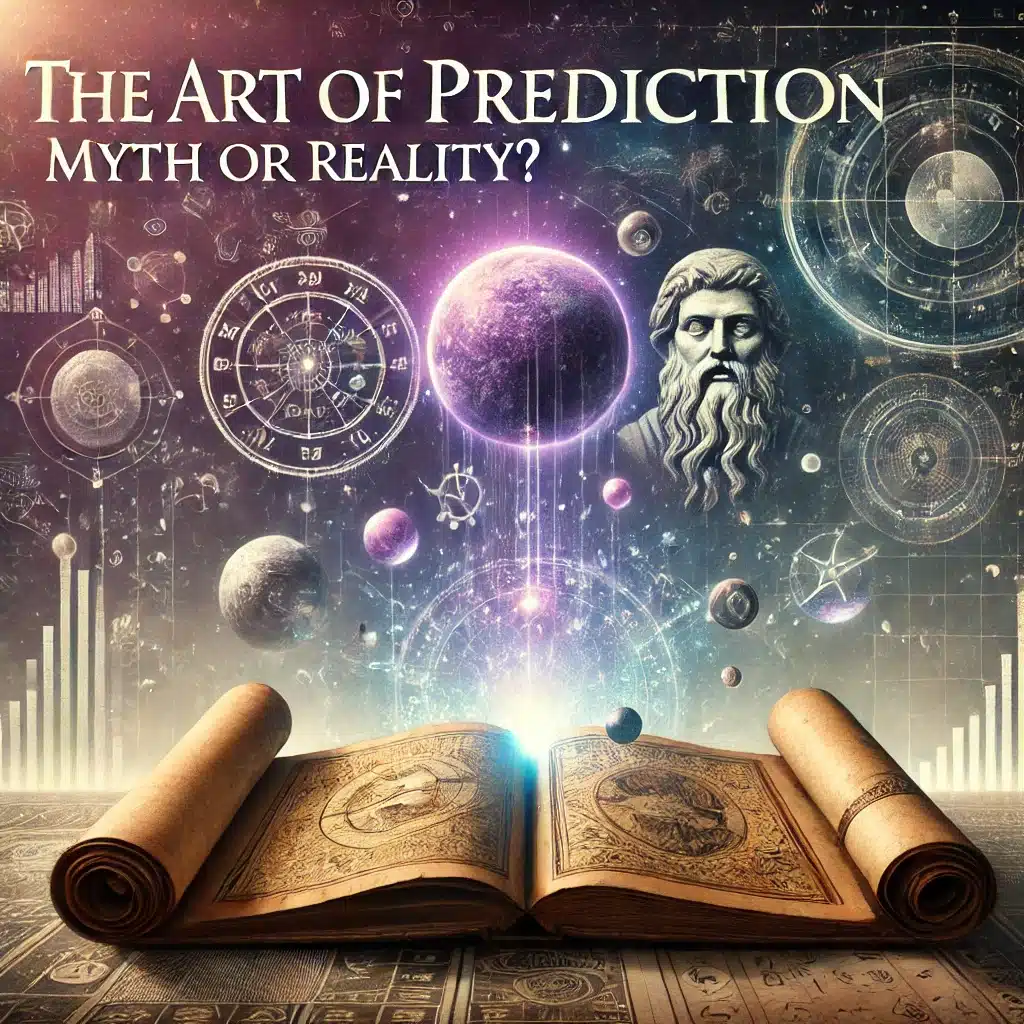
This article explores the art of prediction from scientific and mystical perspectives to see how ordinary people can forecast events in their personal lives or global affairs.
You Can Predict Future Now: 2025 Predictions
Introduction
This is not the first occasion humanity has tried to predict the future. People, from prophets and astrologers to scientists and data analysts, have always wanted to know what is coming. However, can an ordinary person, without mystical knowledge, make valid predictions? This article will cover the fundamentals of prediction, what you need to learn in order to start predicting, and if prediction even exists in reality or is based on some sort of mythology. We also look at a few of history’s most famous predictions to see how much of mythology and how much of science is in the mix.
Can Anyone Predict the Future?
Many people think that only mystics or seers can predict the future, but it’s completely possible to make forecasts with a little awareness and wisdom. Observing trends and using logic is how we daily predict everyday stuff. For example, when we watch the weather patterns, we subconsciously make a guess that it could rain. However, for more important predictions—such as a country’s economic or political future—trained analysts rely on data, pattern recognition and statistical models.
In India, many turn to astrology, a centuries-old complex calculation that is based on planetary positions. At a personal level, anyone can make “predictions” as you tend to know the trends of behaviours, finances, history, etc., which can help make better decisions.
The Basics of Prediction: Science or Mysticism?
Predictions can stem from different foundations. Here are three main types:
- Scientific Predictions: Predictions in science are based on observation, experimentation, and empirical data. Evidence of past behaviour is used to make forecasts, for example, in fields like meteorology, economics, and biology. Most people who get educated in data science, economics, or environmental science are trained in predictive analysis, so they have the tools to make data-based predictions.
- Astrology and Mystical Predictions: Astrology is taken very seriously in cultures such as India. Predictions of planets’ movements and their supposed influence on life are called astrological predictions. For some, astrology is mystical; for others, it is a form of structured (or even empirical) science with roots in ancient traditions.
- Intuition-Based Predictions: Personal predictions tend to come from intuition, or an ‘inner prediction,’ without realizing that subconscious pattern processing in our lives is predicted this way. Though less formed, intuition can lead to personal decision-making, from relationships to career paths and others where logic may not be enough.
3. Is Prediction Mythical or Real?
Prediction sits strictly between myth and reality. Data and testing are how scientific predictions are widely accepted as real and useful. For example, economists rely on data trends, and climatologists predict weather with a high degree of accuracy using trends.
Of course, there’s a grey area for mystical predictions. For example, millions in India practice and respect astrology by using astrologers for guidance. However, scepticism does not have scientific validation, and as such, it remains a belief system more than scientific practice. Mysticism predictions, however, often are open for interpretation and sometimes are general, making it hard to calculate their accuracy regularly.
4. Famous Predictions: Accurate or Not?
Throughout history, many predictions have gained fame, some for their accuracy and others for their mysterious appeal. Here are a few notable ones:
- Nostradamus: The works of this 16th-century French astrologer are legendary for supposedly foretelling everything from Hitler’s rise to 9/11. His writings are sometimes so vague that you can interpret them both to agree and disagree with their authenticity.
- Baba Vanga: Also known as the ‘Nostradamus of the Balkans’, Baba Vanga was also said to have foreseen the 9/11 attacks and Brexit. But, as with Nostradamus, her divine forecasts are often hedged with uncertainties that make for wide-ranging interpretation.
- Y2K: Based on data, I predicted a widespread technology failure in 2000 due to date coding issues. Fortunately, Y2K was successfully mitigated by changing the programming, but it was a seminal moment in that it demonstrated the power of science when it comes to preventing actions in the real world.
- Edgar Cayce: Cayce, who was known as the “Sleeping Prophet,” predicted everything from medical advances to world events. However, predictions about his own health proved amazingly prescient, even if what he said about the fates of mankind is open to debate.
Conclusion
Thus, whether scientific or otherwise, prediction is as much about knowing the unknown as being able to comprehend what we cannot. Not everyone has prophetic things, but we can forecast based on observation, data or personal intuition. One such pathway for us Indians is Astrology, a combination of predictive methods with cultural heritage. Mythical or scientifically sound predictions keep us on our toes, for better or worse — the former to warn us about the road ahead, the latter to bring us more cheer.
FAQ
What are some famous predictions?
Nostradamus and Baba Vanga made notable predictions. Additionally, the Y2K scare and some economic forecasts demonstrated the practical value of scientific prediction.
Can anyone make predictions about the future?
Yes, with observation and logic, anyone can make educated guesses. Data science and probability theory also help with scientific predictions.
Are there formal methods for learning prediction?
Yes. Disciplines like data science, economics, and astrology provide structured methods, while psychology and intuition guide personal predictions.
Are predictions scientifically valid or mythical?
Scientific predictions rely on data, while mystical ones, like astrology, are culturally significant but lack empirical validation.