
Authored by
Kushagra Mahajan
National law institute University(NLIU), Bhopal
A batch of 2026 BALLB Hons
TABLE OF ABBREVIATIONS
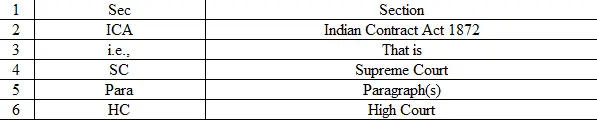
LIST OF CASES
- Bellachi v Pakeeran
- Bhagwan Kaur v Land Acquisition Collector, Ludhiana
- Blay v Pollard and Morris
- MacKenzie v Royal Bank of Canada
- Morris v Burroughs
- Muskham Finance, Ltd. v Howard
- Stanev v Bulgaria
INTRODUCTION
This project is titled ‘The theory of voidable contracts with special emphasis on undue influence, would elucidate the various aspects pertaining to the Indian Contract Act, 1872 especially sections 2(i), 14, and 16. The research would commence with the derivation and the ratio behind these sections followed by the applicability of the same in the present scenario and future thereafter.
Important cases like Subash Chandhra v Ganga Prasad (1966) and Bellachi v Pakeeran (2009) will be analyzed, and conclusions and interpretations will be drawn. The research work would be exhaustive to be able to solve the problem with regard to ignorance and lack of awareness towards voidable contracts. The solution will hence lead to a defense mechanism to protect oneself from unexpected harm caused due to different ways of undue influence.
This project seeks to focus on the similarities present in various significant judgments and how can be avoided to protect the unaware party from being affected. Conclusions and suggestions would be drawn keeping in the mind the rule of law and the law of the land. Judges and lawyers can also infer from the same and assure to try their best to be more vigilant against such malpractices.
REVIEW OF LITERATURE
- Anson’s Law of Contract (29th Edition)
The authors have clearly elucidated the significance of Voidable Contracts and have given exhaustive information regarding undue influence.
- Pollock & Mulla on Indian Contract Act (16th Edition)
This book is referred to comprehend the definitions of the required terms and to differentiate between voidable, valid, and void contracts.
- Avtar Singh’s Contract and Special Relief Act (12th Edition)
The author covers various aspects of voidable contracts and undue influence. These aspects include pardanashin women, inequitable and unconscionable influence, exceptions to voidable contracts, and many more. (We can remove this if u want)
- Journal Article: “Undue Influence and Coercion” By W.H.D Winder
The learned author aids the reader to comprehend the origin of undue influence and know about its ratio and relates to the incumbent position of undue influence globally. (This can stay) Voidable contracts have been pervasive and still unidentifiable and unreported. Irrespective of the essentials provided under Indian Contract Act 1872 the affected cannot achieve complete justice. Undue influence is used unreasonably leading to litigation which is a cumbersome process. Identifying the ratio behind various domestic and international judicial interpretations with regards to undue influence.
HYPOTHESIS
Principles of equality and special emphasis on education are a must so as to protect the deprived. The solution entails a defense mechanism for an individual to analyze the situation at the earliest and confer solutions from competent authorities like lawyers, professors, researchers, etc. Easy to comprehend and easily accessible information should be provided to bring the deprived to an equal footing. These points need to be taken into consideration with the utmost sensitivity, responsibility, and accountability.
METHODOLOGY
The method used is the doctrinal research method. Doctrinal research means research that is carried out on a legal proposition by way of analyzing the existing statutory propositions and cases by applying reasoning power. The research would be focusing on laws confined to India so as to gain a proper understanding of the shortcomings with respect to the concept of voidable contracts and undue influence.
OBJECTIVES OF STUDY
- To understand the concept of voidable contracts
- To understand the position of voidable contracts under ICA
- To understand the derivation and ratio of undue influence
- To analyze the situation of undue influence in the Indian context
- To understand the position of the victims deprived of any recourse/remedy
- To establish a defense mechanism to avoid undue influence
RESEARCH QUESTIONS
- How are voidable contracts and undue influence misused?
- What are the effects of such misuse on the aggrieved?
- How can the victims avoid such malpractices?
- How can the defense mechanism be substantiated as a viable solution?
VOIDABLE CONTRACTS
According to Sec 2(i) of the Indian Contract Act, 1872 voidable contract is defined as “An agreement which is enforceable by law at the option of one or more of the parties thereto, but not at the option of the other or others, is a voidable contract.”
According to Sec 19 of the ICA, 1872 the voidability of agreements is provided as “When consent to an agreement is caused by coercion, fraud or misrepresentation, the agreement is a contract voidable at the option of the party whose consent was so caused.”
According to Sec 53 of the ICA, 1872; Liability of party preventing event on which the contract is to take effect. “When a contract contains reciprocal promises, and one party to the contract prevents the other from performing his promise, the contract becomes voidable at the option of the party so prevented; and he is entitled to compensation from the other party for any loss which he may sustain in consequence of the non-performance of the contract.”
The above definitions clearly mandate the concept of voidable contracts. A contract as defined in the Sec 2(h) of the ICA is something that is enforceable by law but in cases of voidable contracts, it is not an enforceable contract until and unless both the parties agree to the agreement completely without any force, undue influence, mistake and many more.
The ratio behind the definitions is to bring both the parties to an equal footing hence the option of one or more parties is also respected. It can also be derived that the ‘one party’ can either refuse to come into a contract or might agree to perform the say. Therefore, it can be concluded that it is on that ‘one party, who has been put into a situation that mitigates their consent, to decide whether to make the contract thereof void or valid. The questions that need utmost attention here are:1. Is there a stipulated time limit where the ‘one party’ must provide with their assent or dissent? 2. What if that ‘one party’ can’t or doesn’t communicate their assent or dissent to the voidable agreement as stipulated in the above conclusion? 3. Are there any remedies for the ‘other party’ if they bear any kind of loss? These questions shall be answered while looking at the prospects of essentials to a voidable contract.
ESSENTIALS TO A VOIDABLE CONTRACT
Before delving into the aspects of essentials it is necessary to understand the meaning of the term ‘Recission’. The term is defined as the cancellation of the contract and the return of the parties to the position they would have had if the contract had not been made.
Sec 66 of the ICA explains the Mode of communicating or revoking rescission of a voidable contract as “The recission of a voidable contract may be communicated or revoked in the same manner, and the subject to the same rules, as apply to the communication or revocation of the proposal.”
This sec answers question no.1 enunciating that there is a mode of assenting or dissenting to the agreements same as Sec 3 and 5 of ICA. Sec 3 justifies that if any communication, acceptance, and revocation need to be made intention to such action is necessary. Sec 5 justifies that the communication of revocation needs to take place before the communication of acceptance. Hence, we can conclude that recission to voidable contracts requires an intention to do so and timely communication of the same. According to Anson’s Law of contract ‘If the contract is a voidable contract not disclaimed in time, …., it may be enforced as a contract.
This statement by a learned scholar answers question no.2 making the contract valid and enforceable with a complete obligation on both the parties to perform their part if the ‘one party’ can’t or does not communicate his recission.
According to Sec 64 of the ICA, the Consequence of recission of a voidable contract is elucidated as “When a person at whose option a contract is voidable rescinds it the other party thereto need not perform any promise therein contained in which he is a promisor. The party rescinding a voidable contract shall if he had received any benefit thereunder from another party to such contract, restore such benefit, so far as may be to the person from whom it has received.”
This sec answers question no.3 where the ‘other party’ is put into a position as if it has not entered any contract or into a position as if it was before that particular contract. Therefore the ‘other party’ is also respected, and their rights are not ignored.
There are a few other factors that play a significant role in the essentials of a voidable contract: –
According to the explanation of Sec 19 of the ICA if the fraud or misrepresentation exercised or practiced by the promisor does not cause the promisee to cause the consent to the aforesaid contract it is not deemed as a voidable contract.
Hence, the explanation provides another ratio behind defining something as voidable i.e., to render a contract as voidable the ‘other party’ or the promisor has to have (a) an intention to deceive and derive benefits or cause loss and (b) the ill will or the action must have caused the promisee to give their consent to perform the contract. This explanation also provides that one of the two options won’t suffice instead both are required to render something as a voidable contract.
Sec 55 of the ICA, which has been divided into three parts, talks about time as an essential or non-essential or new time agreed upon to conclude a contract as voidable.
(1) The effect of failure to perform at a fixed time, in a contract in which time is essential, when a party fails to perform a certain thing before the stipulated time, provided that the party’s intention behind the contract was that time should be the essence, the contract becomes voidable at the option of the promises.
(2) The effect of failure, when time is not essential, is that though the parties did not have the intention of time being the essence the failure to perform does not make it voidable. Instead, the promisee is entitled to compensation from the promisor for any loss derived from the failure.
(3) The effect of acceptance of performance other than that agreed upon is that post the failure if the promisee agrees upon a new time to perform, the promisee cannot claim compensation for the non-performance by the promisor for the time agreed initially provided the promisor did not perform it intentionally. The sec emphasizes that voidable contracts are not limited to only when they are initiated by force or coercion, instead, voidable contracts can evolve even after non-performance of a certain thing in a valid contract not done in a fixed time.
The sec encourages the fact of voidable contracts seen from a wider perspective entailing a wide scope. As the promisee used to get compensated in normal cases of voidable contracts and the same promisee is still compensated when valid contracts transform into voidable contracts. Hence, voidable contracts being an essential part of the ICA stands true.
The questions that now arise are: 4. What all comes under the ambit of voidable contracts is it only those mentioned under Sec 14 of the ICA or is it flexible? 5. How are voidable contracts different from valid and void contracts and how can the same be determined? These questions shall be answered while discussing the significance of voidable contracts.
SIGNIFICANCE OF VOIDABLE CONTRACTS
According to Sect 14 of the ICA, if consent is caused by coercion, undue influence, fraud, misrepresentation, or mistake the contract is said to be rendered voidable at the will of the ‘one party’. The ratio behind the same is that consent, as defined in Sec 13 of the same Act, is when two or more persons agree upon the same thing in the same sense. But in cases of coercion, undue influence, and others the party whose consent is caused doesn’t agree to the same thing in the same sense as it possesses an intention of either not performing the contract or agreeing differently. Hence, to deem something as a valid contract meeting of minds is a must.
According to the Sec 31 of the Specific Relief Act, 1963 provides when cancellation may be ordered the Sub Clause (1) of the Sec states that “Any person against whom a written instrument is void or voidable, and who has a reasonable apprehension that such instrument, if left outstanding may cause him serious injury, may sue to have it adjudged void or voidable; and the court may, in discretion, so adjudge it and order it to be delivered up and canceled.”
This answers question no.4 proving that the deprived or soon-to-be deprived can sue to render a contract voidable and after the discretion of the court can be rewarded compensation. Hence, voidable contracts entail various prospects and are reasonably flexible.
According to Sec 2(g) and (j) of the ICA ‘An agreement not enforceable by law is said to be void.’ and ‘A contract which ceases to be enforceable by law becomes void when it ceases to be enforceable.’ According to Sec 2(h) of the ICA ‘, An agreement which is enforceable by law is a contract.’ According to Sec 10 of the ICA “All agreements are contracts if they are made by the free consent of the parties competent to contract, for a lawful consideration and with a lawful object, and are hot hereby expressly declared to be void.” This answers question no.5 in assisting to conclude the difference between the three terms as valid is something that has fulfilled all conditions under Sec 10 void is something that is not denied by the law of the land and voidable is something that is flexible on the option of the party that is not on equal footing. Hence to determine whether a contract is valid or void or voidable the conditions under Sec 10 play a very important role.
Voidable contracts encompass few other significant roles in the ICA as under Sec 178A the pledge by a person in possession under a voidable contract is illustrated.
“When the pawnor (bailer) has obtained possession of the goods pledged by him under a contract voidable under Sec 19 or 19A, but the contract has not been rescinded at the time of the pledge, the pawnee (bailee) acquires a good title to the goods, provided he acts in good faith and without notice of the pawnor’s defect of title.” This sec showcases that the concept of voidable contract has wide applicability even covering the concept of bailment.
Therefore, in conclusion with regards to the research on voidable contracts the concept is pervasive and exhaustive in nature. But the issue that has been prevalent in the recent past has caught the researcher’s eyes. And it deems fit to understand how voidable contracts can be misused by either of the party to cause detriment to the other party. But before delving into the same the researcher would like to briefly discuss one of the key concepts in voidable contracts i.e., Undue Influence.
UNDUE INFLUENCE
According to Sec 16 of the ICA undue influence is defined under Sub Clause (1) “A contract is said to be induced by ‘undue influence’ where the relations subsisting between the parties are such that one of the parties is in a position to dominate the will of the other and uses that position to obtain an unfair advantage over the other.”
According to Sec 19A of the ICA, the power to set aside a contract induced by undue influence is authorized “When consent to an agreement is caused by undue influence, the agreement is a contract voidable at the option of the party whose consent was so caused. Any such contract may be set aside either absolutely or, if the party who was entitled to avoid it has received any benefit thereunder, upon such terms and conditions as to the Court may seem just.”
The definition and the responsibility provide a lucid concept of undue influence that protects a party from being unjustly held obligated to perform a contract under the influence of their family members or any other fiduciary relationship.
The rights of the deprived party are also upheld provided they plead it to be rescinded under the Court or any other equivalent authority. The concept at hand brings across a few questions like 6. How did the concept of undue influence come into existence and what is the ratio behind it? 7. How can a court establish whether a relationship can influence consent to a contract?
The principle of undue influence was primarily enunciated by Lord Hardwicke in Morris v Burroughs (supra) with regards to the relationship of parent-child. The Lordship said that parental authority is great to prevent any undue influence and it may prejudice the children and in all cases of such kind it is necessary to consider moving from the father and child benefiting from it. This reference from an article titled ‘Undue Influence and Coercion’ answers question no.6. The researcher also found out that in earlier cases parental authority was expressed as ‘awe’ instead of ‘undue influence. The ratio behind the presumption of such influence was not the terror or fear of the parent but instead the kindness and affection, which bias the child’s mind. It was also believed that the mere existence of a fiduciary relationship raises the presumption of undue influence and the burden of proof lies on the person that so caused the consent.
According to Sec 16 of the ICA Sub Clause (2) “a person is deemed to be in a position to dominate the will of another- (a) where he holds a real or apparent authority over the other, or where he stands in a fiduciary relation to the other; or (b) where he makes a contract with a person whose mental capacity is temporarily or permanently affected by reason of age, illness, or mental or bodily distress.”
These sec answers question no.7 where the court can assume to establish a relationship as an influence to make the parties obligated. The ratio behind the same can be interpreted as consent not being qualified to lead to a manipulated decision. A person of unsound mind cannot be believed to have comprehended the terms of the contract and if any such contract still comes into existence it can be derived as the contract being forced and hence avoidable.
Hence it is understood that undue influence can be easily presumed if a relationship of trust exists between the parties. But the dire problem that comes with this interpretation is the veracity of the fact of the influence actually being present. The question so raised can be: 8. Whether the person claiming to be influenced was actually influenced or in the lieu of the contract he wished to put the other party at disadvantage? 9. Whether the person whose consent was so caused was able to approach the court for justice or was he deprived of his rights and forced to fulfill contractual obligations? These questions shall be answered while discussing the cases related to undue influence.
JUDICIAL INTERPRETATION OF UNDUE INFLUENCE
In MacKenzie v Royal Bank of Canada (supra) the Privy Council declared that “It may be true that in some cases it is easy for the wife to discharge the onus which lies on her as on everyone else outside the protected classes to show that particular contract was, in fact, procured by the undue influence of her husband.”
Another case namely Bellachi v Pakeeran (supra) where the facts were such a sister (appellant) and her brother (defendant) had executed a sale deed in favor of the defendant. Following the deed, the sister filed a petition to claim that the deed was completed under misrepresentation, undue influence, and collusion making her believe that she would obtain financial assistance. She even presented that her husband was suffering from a prolonged illness and was on bed rest. Whereas the defendant submitted that the execution of the contract was done voluntarily.
Thereof, the SC in this regard held that the plaintiff was not able to establish that the defendant was in a position to dominate and that the sale deed was executed under misrepresentation and undue influence. The plaintiff herself being a literate woman, with a government job and financially sound seemed to be reasonable enough to understand the contract and assert herself. Hence, the court dismissed her appeal. These cases clarify question no.8 that a person claiming to be influenced can recklessly misuse their rights to hold the other party accountable and conveniently shift the burden of proof to the other party.
Therefore, it is necessary for the courts to take into consideration all the aspects relating to mental capacity, financial soundness or any kind of prejudice.
In the case of Stanev v Bulgaria question, no.9 was answered as to how a certain condition can provide justice to a person when he is deprived of the same. It was clearly stated on page 11 of 46 of the judgment under the heading ‘E. Validity of contracts signed by representatives of incapacitated persons’ para 54. “In accordance with sec 27 of the same Act, contracts entered into by representatives of persons deprived of legal capacity in breach of the applicable rules are deemed to be voidable. A ground of incurable nullity may be raised on any occasion, whereas a ground of voidability may be raised only by means of a court action.”
This regulation shows that a robust ground is present to protect someone deprived of legal capacity. Hence in the jurisdiction of Bulgaria, an individual has assured equality at all levels of contracting and is not deprived of his rights at any point. But the question that needs attention is: 10. Whether such law is present and applicable in India, if not how can it be implemented?
The researcher has covered one of the key aspects of voidable contracts and has even analyzed that a defense mechanism is required to protect not only those whose consent has been caused but even those who have caused it or are believed to have caused it. Therefore, these would be achieved in the following conclusion and suggestions.
CONCLUSION
In the HC of Punjab and Haryana at Chandigarh a case decided on 18th July 2012 namely Bhagwan Kaur v Land Acquisition Collector, Ludhiana (supra) it was held in para 8 of the judgment delivered by Justice K. Kannan that “In cases where a transaction is said to be affected by non est factum with a plea available for a person, who did not know of the nature of the document and he was illiterate, the Courts have expressed such transaction to be not merely voidable but even void.
The point, however, would be whether a plea of non est factum had been made and evidence was adduced to that effect.” The researcher is glad to know that robust conditions are also present in the legislations of India hence this case answers question no.10. The concept of non est factum as defined by Black’s Law Dictionary is a form of a plea by which the defendant alleges that, although he executed the deed yet it is in law ‘not his deed’. Hence in India an individual who is not aware of the nature of the document can plead for non-compliance with any kind of performance to the contract provided a plea was initiated and substantial evidence is provided. Although India seeks to protect the party, whose consent was so caused other such legislations are needed especially for the illiterate.
Non est factum which acts as a strong option for the deprived can adversary affect the other party. hence the relevant question to look upon is: 11. Whether the other party can prove the plea as frivolous or maliciously intended?
In Muskham Finance, Ltd. v Howard (supra) it was made clear that the effect of a successful plea can make a document not only voidable but even void. But it was emphasized as a narrow defense. Those too lazy or too busy to read through the terms and conditions of the contract before signing it cannot rely upon it even if it contains objectionable or ambiguous terms. Donovan LJ asserted “Much confusion and uncertainty would result in the field of contract and elsewhere if a man were permitted to try to disown his signature simply by asserting that he did not understand that which he had signed.”
In yet another Blay v Pollard and Morris (supra), the defendant signed a document believed to be of dissolution of a partnership. But the document also contained a term, which had not been mentioned in any of the previous oral agreements, making him liable to indemnify fellow partners in respect of certain liabilities. It was therefore held that the defendant was bound by his signature. These cases signify the importance of parties taking utmost care and caution while fulfilling or reading the essential terms. Hence to be on an equal footing, i.e., one of the objectives of voidable contracts it is recommended to be aware of the conditions of a contract completely.
The following suggestions can help in creating a defense mechanism for both parties depending on the situation.
SUGGESTIONS
The researcher suggests that remedies for the aggrieved party, which can be the ‘one party’, whose consent has been caused, or the ‘other party, who has the burden of proof (as mentioned in Sec 16 (3) of the ICA), can be derived from the research.
The points that need to be kept in mind while forming a contract are the following: –
- Assert Yourself
Never show the opposite party as you can be manipulated or influenced. Be confident and ask as many questions as you can to acquire in-depth knowledge of the obligations and accountability if any.
- Consult Professionals
Legal representatives must always be consulted while delving into a new contract involving performance. If any misuse of authority by the said council is witnessed, strict actions must be initiated and competent courts under jurisdiction must award the victim with compensation and counsel being disbarred.
- Awareness Programmes
The rural areas require to know about the current and relevant laws associated with their day-to-day activities and should possess adequate information about their rights and duties as a citizen of a particular country. Hence the State and Central Government should form an Awareness Committee that can educate the underprivileged and be held accountable for anyone being excluded from this process.
- Legislation of relevant laws
Implementation of new laws with respect to the law of the land can be assumed to bring a drastic change in any kind of mishappening that has happened in the past. The legislature should develop a cogent law respecting the rights of those who can be harmed and affected.
BIBLIOGRAPHY
- Black’s Law Dictionary < https://www.latestlaws.com/wp-content/uploads/2015/04/Blacks-Law-Dictionery.pdf >
- Indian Contract Act, 1872 < https://legislative.gov.in/sites/default/files/A1872-09.pdf >
- JSTOR < https://www.jstor.org/ >
- Manupatra < https://www.manupatrafast.com/?t=desktop >
- SCC Online < https://www.scconline.com/?login=true >