
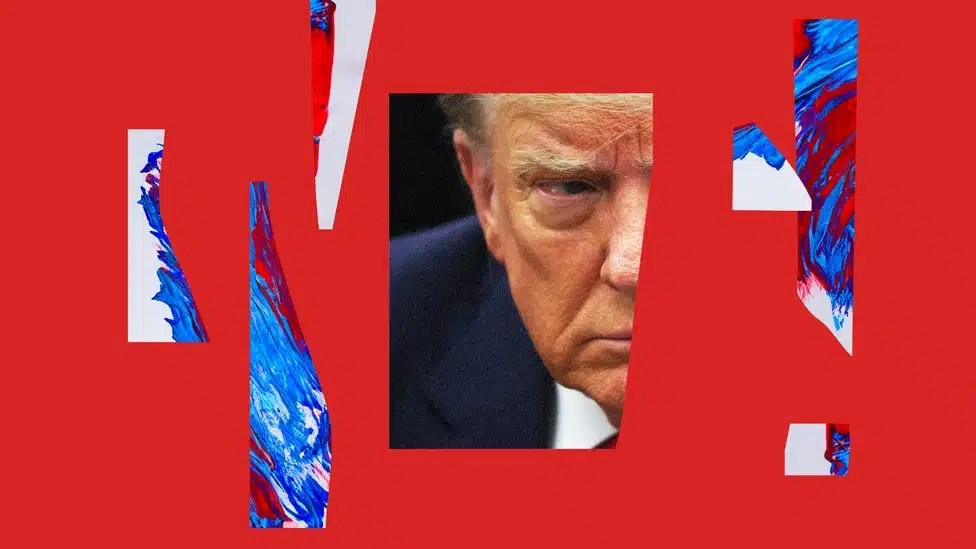
In the wake of former President Donald Trump’s entanglement with the law, the United States finds itself at a historical crossroads where the robustness and impartiality of its legal system are under the microscope. Trump, a figure who has long navigated the tributaries of public opinion, now faces the stringent currents of legal scrutiny, where the rules are unyielding, and the room for rhetoric is narrow.
The scene is reminiscent of a grand courtroom drama, but the stakes are far from fictional. The adversaries are formidable: on one side, a former President known for his Teflon-like ability to sidestep controversy; on the other, a legal system grounded in the protection of rights and the pursuit of justice. It’s a scenario ripe for the silver screen, yet it unfolds in the sober halls of American courthouses.
Trump’s journey from the arena of public opinion to the courts of law marks a transition from a world where narratives can be shaped and swayed, to one bound by the rigid structures of legal procedure and evidentiary rules. His critics, some who have long awaited this moment, may envision a straightforward path to accountability. However, the reality of the American criminal-justice system, with its deep-rooted protections for the accused, presents a more nuanced battleground.
The cornerstone of the system is the presumption of innocence and the principle that it is better for ten guilty persons to escape than for one innocent to suffer, as stated by English jurist William Blackstone and later reinforced by American founding father John Adams. This ethos was put to the test during Adams’ defense of British soldiers in the Boston Massacre trial, where he successfully argued for the acquittal of his clients, despite public outcry. It was a defining moment that underscored the importance of legal defense, even for the most reviled.
Trump’s legal challenges encompass a plethora of accusations, including obstruction of justice, electoral misconduct, and financial improprieties. The rules of evidence and the constitutional protections granted to all defendants mean that not all information known to the public may be deemed admissible in court. This gap between public knowledge and admissible evidence could significantly influence the trials’ outcomes, serving as a litmus test for the prosecutors and a potential source of frustration for Trump’s critics.
Moreover, the statutes under which Trump is being prosecuted, including 18 U.S. Code § 371 (conspiracy to defraud the United States), § 241 (conspiracy against rights), and § 1512 (obstruction of official proceedings), are broad and subject to interpretation. The Supreme Court’s recent trend towards a narrower reading of such statutes, ostensibly to avoid constitutional pitfalls, may further complicate the prosecutorial effort.
The prosecutorial burden is to establish guilt beyond a reasonable doubt, a high bar that ensures the protection of defendants’ rights but also presents a significant challenge for the state. Trump, or any defendant, is only required to sow doubt among jurors, seeking to prevent a unanimous verdict. It is a reminder of the gravity and complexity of the legal process, one that does not bend to public sentiment or political pressure.
As the legal proceedings gain momentum, the American public will be watching closely, and Trump’s opponents will need to grapple with the slow, methodical pace of justice. The integrity of the process demands that they, along with the rest of the country, respect the rule of law and the outcome it produces, regardless of personal sentiment.
In conclusion, as Trump contends with the myriad of legal proceedings, the unfolding drama is more than just about the potential culpability of a single individual. It is an examination of American jurisprudence and its capacity to administer justice impartially, a test of societal commitment to the rule of law over the rule of popular opinion. It is a process that may well cause angst among Trump’s critics, who must resist the impulse to condemn the system should it not yield their desired outcome.
In the end, the trials of Donald Trump will not only decide his fate but also reaffirm, or challenge, the foundations of American legal philosophy and the societal values it embodies. Whether one views Trump as a defendant or a former President, the sanctity of the legal process and its outcomes must remain inviolable for the sake of the nation’s commitment to justice.