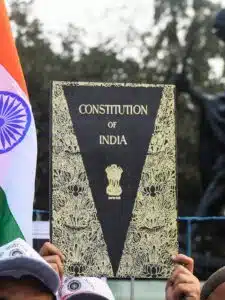
One of the examples of the Indian Constitution being called a living law is the fact that it changes according to the needs of society. This does not mean the basic essence of what we call the basic structure of the Constitution also changes. Going back to 2020, that is, the time exactly before the pandemic hit across the globe and before India announced its lockdown; we must have remembered the protests and agitations across the country. But why were such protests by students and human rights activists took place in such large numbers? Was it relating to a Constitutional matter? This article will look into the concept of equality under the Indian Constitution and would also analyze the right to equality provided under the Indian Constitution.
Equality is part of the rule of law
Whenever we analyze, or any question arises with respect to Article 14 of the Indian Constitution, it becomes significant to relate the same and answer the issue through the rule of law propounded by AV Dicey. One of the three pillars that were proposed by AV Dicey was ‘equality before the law’. This means that everyone is subjected to the law, and no one is above the law. By this, he meant that ‘Law is the King and even King should be subjected to law’. This is the phrase that finds its place indirectly in the Constitution of India, under Article 14 of the Indian Constitution. One of the examples of such would be the president and the Constitution, where the President of India is the executive head of India. But, as per dicey and even under article 14, the President is also subjected to the law, that is, the Constitution of India.
Article 14 of Indian Constitution:
Starting from Article 14 to article 18 of the Indian Constitution, the right to equality has been protected by both the Constitution as well as by the judiciary. It has been regarded as one of the crucial cornerstones of Indian Democracy. It states that no person shall be denied of their right of equality before the law or equal protection of law within the territory of India. The question here is that whether Article 14 is applicable only to citizens or applicable to both? The answer for the same is that it is applicable both to citizens and non-citizens as well. This means that a foreign official staying in India for any reason shall also be subjected to get equality or equal treatment of law. Article 14 gives two main aspects, are
- Equal protection of the law: this aspect speaks on ‘legal equality, where the government should ensure that equals are being treated equally and unequal are treated unequally. This kind of equality is considered to be positive in nature.
- Equality before law: On the other hand, here it speaks on ‘ideal equality’, which means that all are treated equally. It is negative in nature.
But why is equality before law negative in nature? This is because of the fact that if we follow this kind of equality, then it would never serve justice, and no person shall be considered based on their socio-economic status, and reservation policies would never be possible for social development. This is the reason for which India, as per its founders’ opinion, follows equal protection of the law. There are few exceptions that can be seen for equality provided under Article 14 of the Constitution. They are,
- Article 31C states that if any law is made for the purpose of implementing anything that has been provided under Directive Principles of State Policy, and then the same shall not be questioned on the ground of article 14 and article 19 of the Constitution. One best example can be laws relating to women and children for their welfare.
- Article 359(1) state that in case of any emergency, all the fundamental rights can be suspended except the ones which are provided under article 20 and 21 of the Constitution.
The doctrine of Reasonable Classification under Article 14
In the case of Y Srinivasa v. J Veeriah, the issue was with respect to the grant of license in order to run the fair price retail shops. With respect to the same, the government had preferred less educated candidates over the educated. The petitioner, who was a graduate but unemployed but, had experience. He filed a petition for discriminating against him and giving such work to a 10th pass person. The main question was what reasonable classification under Article 14 of the Constitution is.
Court laid down the doctrine of Reasonable Classification, and in this case, it stated that India follows the policy of equal protection of the law, and article 14 permits only the classification and not the class legislation, which results in treating equals unequally without the reasonable justification at all. Thus it held that reasonable classification is a classification that should not be arbitrary in nature, artificial, and not evasive.
The first part of its reasoning was that classification should be real and substantial between the people who have been made as a group and the people who have been excluded from that group. The second part stated that this classification should have a just and reasonable connection with the purpose which has been sought to be achieved by a particular law or statute.
Apart from the same, it laid the Twin Test for classification under the article. That is 1. The classification should be based on intelligible differentia – that is, there should be real and substantial differentiation, 2. The classification should have a rational nexus with the object of the law.
Article 14 and its Applicability:
It is important to note that when a law is enacted, it is not necessary for the legislature to make a classification in the legislation itself. It is up to the executive or the administrator to look for them based on necessity. But, on the other hand, if the object of the act or the classification has been provided under the act, it is the duty of the executive to ensure that the policies and principles are made as per the law. If such discretionary power is misused by the executive, then the same shall be deemed to have violated the concept of equality under the Constitution and the same shall be declared invalid.
It would be great to conclude the same with Justice Bhagwati’s opinion that, ‘Article 14 aims to prevent arbitrariness in the actions of executive and legislature, and it ensures fairness and equality of treatment. Non-arbitrariness pervades Article 14 like Brooding omnipresence.’