Authored by: Yash Jalohna
Introduction
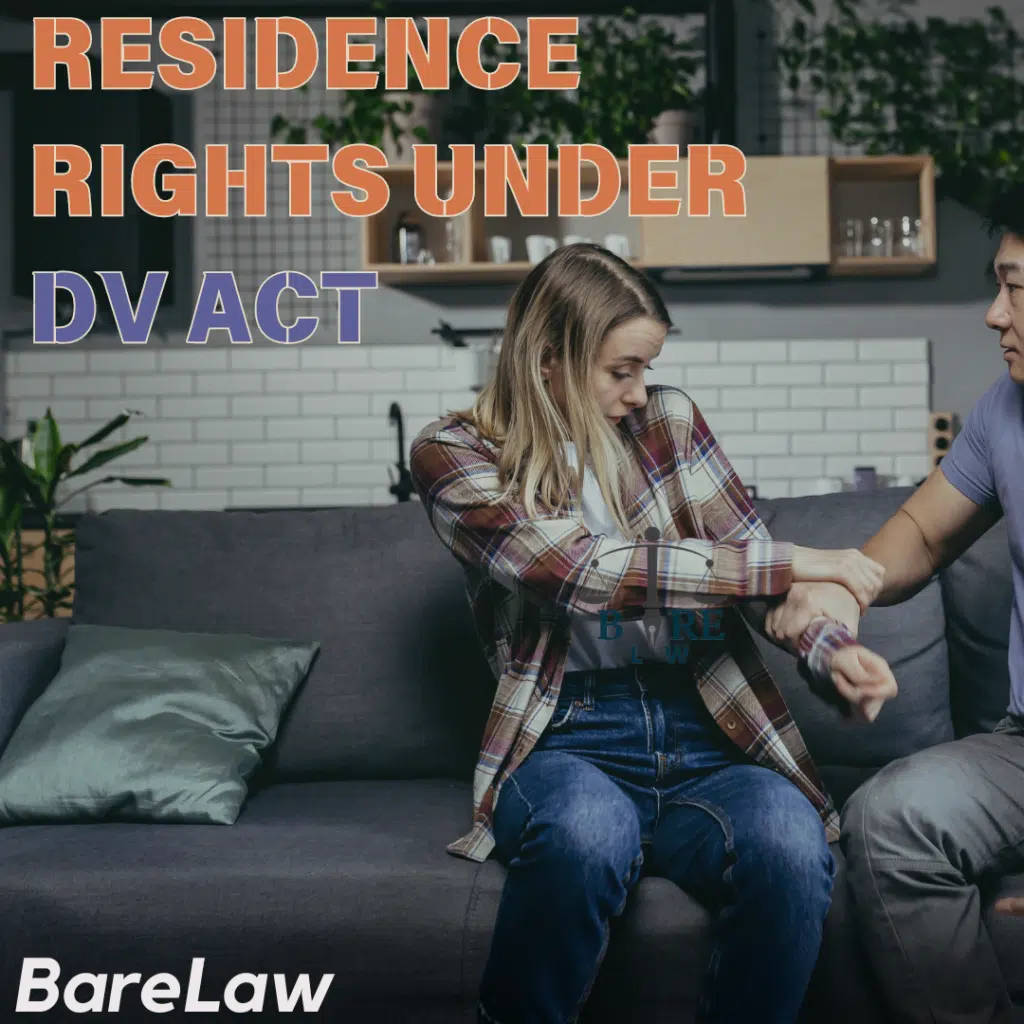
Protection of Women from Domestic Violence(DV) Act,2005 was enacted due to increasing number of cases related to women facing physical abuse, verbal abuse, emotional and financial abuse while being in a domestic relationship. This Act safeguards the rights of a women after getting married. ‘Aggrieved Person’ is used for the women who is in a domestic relationship with the respondent and alleges to be a victim of domestic violence. The DV Act’s framework aims to safeguard women’s rights in domestic relationship and guarantee that they live in a secure environment free from coercion or abuse.
This Act ensures the safety of the aggrieved party, punishment for the respondent and further make sure that reasonable steps should be taken to not let the Act be committed again against the aggrieved party. For the safety of the women, court assigns a particular place of residence to the aggrieved party. All those residence rights are mentioned in Section 19 of this Act.
Aggrieved Person-
In this Act, Aggrieved person means a women who is a victim of domestic violence and decides to sue the person committing this offence in the court of law. Magistrate, after being satisfied that aggrieved person is the victim of domestic violence passes a residence order to help victim to get a place of residence. The court ensures the place of residence so that the woman is not left homeless or vulnerable untill the case is pending or after the judge declares the verdict. According to Section 17, aggrieved party has rights to reside in the shared household.
Restrictions on Respondent-
Court might restrict respondent from dispossessing the aggrieved party from shared household. The court might also ask respondent to remove himself from the shared household. The Respondent will have a obligation towards the victim to have a consent before disposing or alienating the shared household. The respondent may be asked by the court to provide alternative housing or pay rent if the aggrieved party is unable to live in the shared household.
Protection Order-
The court also takes few additional measures for the safety and security of the victim of domestic violence. Court instructs the police officer in-charge of the police station nearest to her residence to assist the aggrieved party on application by her. The court also authorizes the police of the nearest station to assist with the protection order. The court also legally warns the respondent not to commit the offence again.
Legal Remedies-
Magistrate assures the aggrieved to provide money to fulfil their basic needs. They make respondent execute a bond to restrict him from repeating the offence of domestic violence again. Court also directs the respondent to return the valuable properties known as stridhan to the aggrieved which she was entitled for.
Case Laws-
(i)Shiv Prasad v/s Manju, 2011
In this particular case, aggrieved person married the respondent. After few months, Respondent started harassing her wife mentally and physically for not fulfilling the demand of ‘Motorcycle’. The court ordered the respondent to provide maintenance to his wife and will be liable to pay rent not more than Rs.4000.
(ii) Amardeep Sonkar vs State Of U.P. And Another, 2024
The case specified about the residence as well as restrictions upon the respondent for the safety of the applicant. She was a victim of of physical abuse and filed a case under Domestic Violence Act, 2005. Court asked the local police station to provide safety to the aggrieved and lodge a report in appropriate cases. Respondent was restrained from repeating the offence, harassing or try to contact the aggrieved and was directed to vacate the place near her residence and stay away from her residence.
(iii) Smt. Nidhi Bhola vs Sh. Lalit Bhola, 2010
This case became a precedent for the cases involving stridhan and other valuable properties which was entitled to the wife. Magistrate ordered the respondent from not dispossessing the aggrieved and transferring all the valuable properties to his wife which was entitled to her.
Conclusion
Regardless of whether they own any title or rights to the property, the Domestic Violence Act, 2005 guarantees women the freedom to live in the same household whether they are married, in a relationship that is similar to marriage, or in a domestic relationship. According to the Act, a woman cannot be removed from the shared household by Respondent or his relatives unless it is concluded by law. This clause aims to protect women’s housing rights and safeguard them from becoming homeless due to domestic abuse or disagreements. The aggrieved party still has the right to live in the shared household even after she has departed, should she so desire. To guarantee her safety and well being, the courts may also impose monetary sanctions or alternative housing.