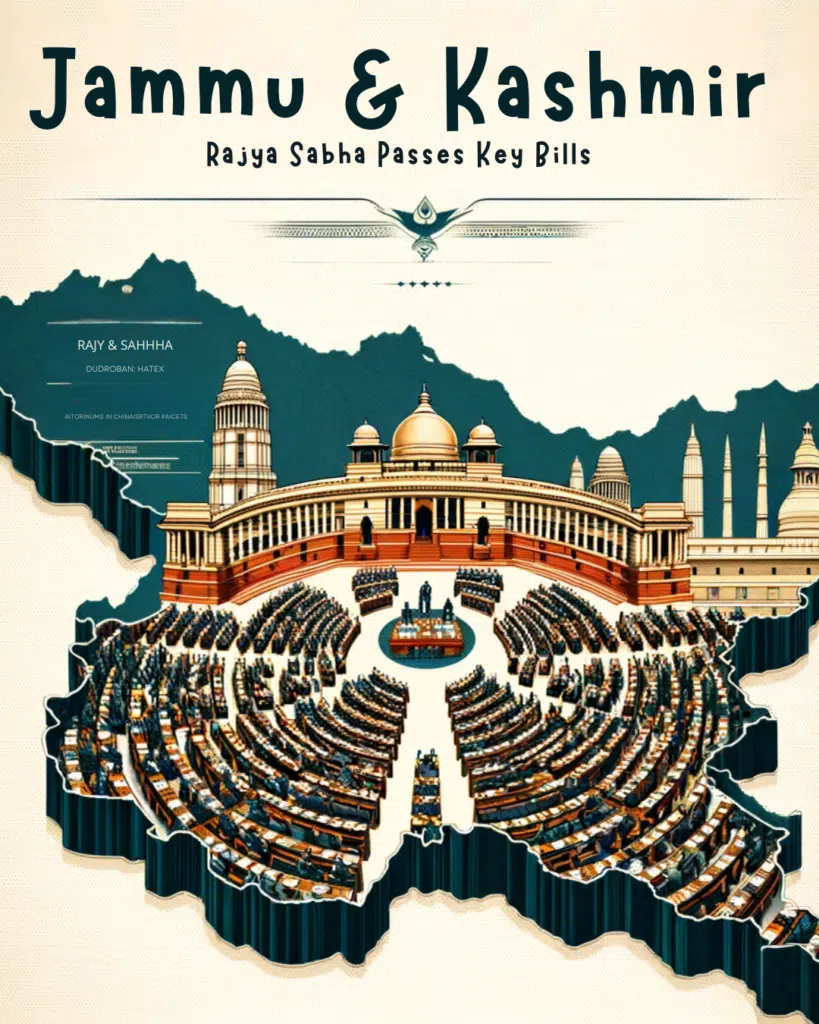
Historic Legislative Changes in Jammu and Kashmir: Rajya Sabha Passes Key Bills”
Introduction
India’s Rajya Sabha, the upper house of Parliament, marked a significant milestone on December 11 by passing two critical amendments affecting the governance and legislative structure of Jammu and Kashmir. These bills are set to redefine the political landscape of the region and could shape its future development and integration into the Indian Union.
Passage of Bills Amidst Political Walkout
In a session that concluded with no dissenting voices, the Jammu and Kashmir Reservation (Amendment) Bill, 2023, and the Jammu and Kashmir Reorganisation (Amendment) Bill, 2023, were unanimously passed. This development came after opposition parties staged a walkout, allowing Home Minister Amit Shah to present the bills without obstruction.
Reservations and Reorganisation Acts Amended
The Reservation (Amendment) Bill modifies the 2004 Act, changing the definition of “weak and under-privileged classes” to “other backward classes” as per the Union Territory’s declarations. This move is seen as aligning the local laws with contemporary social realities.
The Reorganisation (Amendment) Bill increases the legislative assembly seats from 107 to 114, ensuring representation for marginalized communities. It also introduces the nomination of Kashmiri migrants and women to the assembly, reflecting a commitment to inclusivity.
Context of Article 370’s Abrogation
These legislative changes are against the backdrop of the abrogation of Article 370, which stripped Jammu and Kashmir of its special status. The Union Home Minister asserted that the new Kashmir will render justice to those deprived of their rights for decades and emphasized the region’s integral part of India.
Supreme Court’s Affirmation
Further cementing these changes, the Indian Supreme Court upheld the abrogation of Article 370, affirming the central government’s move as constitutional and setting a timeline for elections in the region by September 30, 2024.
Conclusion
These legislative developments are not just administrative but carry deep implications for the region’s socio-political fabric. While they promise justice and inclusivity, they also open up debates on federalism, autonomy, and national integration. The eyes of the nation and the world will be on Jammu and Kashmir as it navigates this transformative phase.