On Meeting with Goverment head does not mean ‘Some Deal Is Cracked’: CJI DY Chandrachud
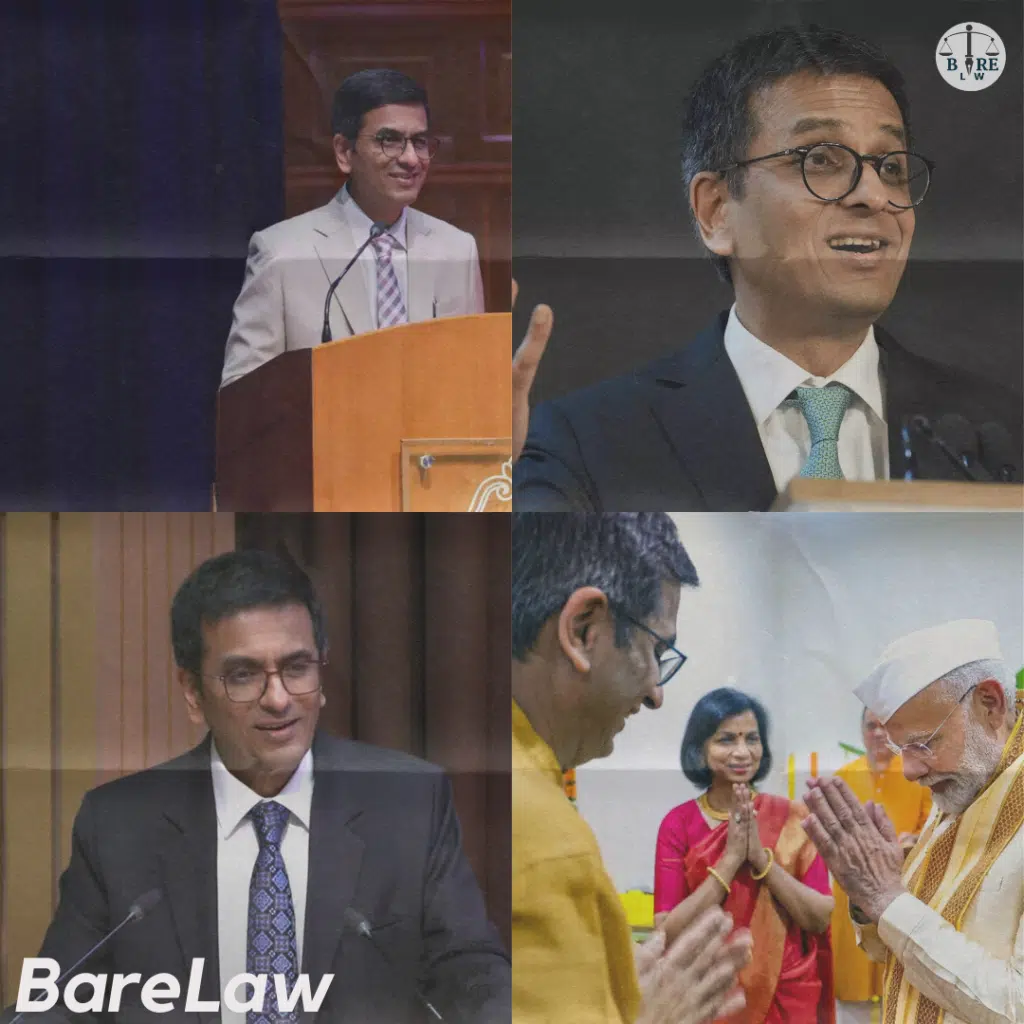
Whenever the heads of the government, whether in a State or at the Centre, meet the Chief Justice of the High Court or the Supreme Court, they stick to ‘political maturity’ and would never speak about a pending case; Chief Justice of India CJI DY Chandrachud said Saturday.
‘We do meet but it’s not like there is some deal cracked.’ The Chief Minister (CM) of the State will have to provide budgets for the Judiciary, and we will have to be in dialogue with the Chief Minister. This budget is not for judges. Our work isn’t done unless we meet and rely on letters. The CJI said but when we meet, there is a great deal of maturity in the political system, in those meetings then a CM will never speak of a pending case in my experience.
Earlier this month, Prime Minister Narendra Modi’s visit to the CJI’s residence for Ganpati Puja triggered a row.
Judicial work is different from the administrative relationship of the court with the government. The CJI emphasised that the same thing operates at the central level.
The judicial work done by the apex court is very different from the ‘administrative relationship’ the Supreme Court has with the Government of the day. CM or Chief Justice usually meet each other on festivals or bereavement — it’s a tradition. Surely, we must be mature enough to understand it has no bearing on our judicial work. We must understand that one will not ‘adjust’ something in a public meeting. The way we judge is not important: we need to accept there has to be a continual dialogue. They can’t mess with the work that we do as judges; we are completely independent. ‘But, in so many ways, at the place of intersection of government work on the administrative side, and the work of the judiciary, there is an intersection,’ CJI Chandrachud said.
A lecture series held by a Marathi daily newspaper on the University of Mumbai campus was the stage for the CJI’s remarks.
On Judges’ Vacations:
In a query about the criticism of the judiciary over their ‘vacations,’ the CJI, while highlighting the fact that he himself starts his daily work at 3:30 a.m., said people must realize that the judges are overburdened with work. They require some time to think and ponder the law as their judgments decide the future of our society.
CJI said that the Indian Supreme Court judges decide 181 cases in a year, while the American Supreme Court Judges decide 181 cases on Mondays. Further, he added that the Indian Supreme Court handles roughly 50,000 cases per year.
The access to justice is our model. There can often be a question as to why what seems to be cases of lower value — the quanta or bail, or grievous hurt or cases of cheating, for example — find their way to our SC, and my answer is this is a people’s court, and no one should be denied access to justice. People in our society play a great deal in the denial of justice. In Singapore, judges are given at least a week to determine how to decide on an issue. We also don’t have such a facility. CJI Chandrachud said we do one job, and then we get another job immediately.
Speaking about the usual day in a judge’s life, the CJI pointed out that he wakes up at 3:He does his workout and other personal work until 6:00 AM and at 30AM, his actual work starts.
‘Monday is not for our papers, so we’re supposed to read them on Sunday.’ Our dictation work for our finished judgment is done on Saturdays. We dictate judgments for at least six weeks in the May 7-week vacation period. Today, what we are deciding will determine the future. Our society of the next 75 years will be shaped by our judgment. Do we give time to the judges? Do you want sufficient time to think and read about the law, or do you just want them to be merely mechanical instruments in the statistical disposal of cases? CJI Chandrachud stressed that judges take time to ponder what should be done for the progress of society, etc.”
The work of judges is multiplied as they go higher in their careers, in volumes, and in complexities, unlike in Western countries.
They are not on vacation gallivanting or goofing up. It is work that judges are deeply committed to, even on vacation. Even Saturday or Sunday is no holiday for any judge. Many judges go out for weekend work, some functions, some HC visits, legal aid work, etc. “I always try to return home on Saturday itself, when I go somewhere for work, so that I can finish my Sunday’s work,” said Chandrachud.
On Collegium:
Responding to a question on if the government, too, takes under consideration the SC’s recommendations, the CJI said that the Collegium system has the court(s) and even the government at the Central and State levels take decision on the candidates for judgeship. Judiciary, government continuously in dialogue about the same, he said.
This is part of the consultative process of listening to different voices, of a dialogue, but within it there is a consensus.” Sometimes consensus doesn’t happen but that’s a part of the system and I think we have the maturity to accept that this reflects the strength of the system. Our dialogue is mature. I can tell you that I have not a single proposal hanging with me. ‘The received proposals I ensure to forward to the government within a week,’ CJI Chandrachud said.
There are things that are good about every institution and every institution is capable of being better. Now if there are indeed positive institutional improvements, that does not mean that the institution is fundamentally flawed. These institutions have been around for the last 75 years, and that should give us a reason to trust our system, our democratic govt which helps our system evolve, the CJI added.
-

SUMMARY SUIT UNDER THE CIVIL PROCEDURE CODE | Rules of Order 37
THE ACT: ORDER XXXVII of the Civil Procedure Code deals with the institution, guidelines and awards (if awarded) that are to be followed in Summary Suits.
-

South Africa Accuses Israel of Genocide in Gaza at International Court of Justice
South Africa Accuses Israel of Genocide in Gaza at International Court of Justice The recent proceedings at the International Court of Justice (ICJ) mark a significant development in international law and relations. South Africa has initiated a case against Israel, accusing it of committing genocide in Gaza. This move by South Africa, representing a coalition…
-
Lucknow Development Authority v MK Gupta, 1994 SCC (1) 243
Lucknow Development Authority v MK Gupta, 1994 SCC (1) 243 Case Name Lucknow Development Authority v. M.K. Gupta Citation (1994) SCC (1) 243 Court Supreme Court of India Date of Judgment 19th October, 1993 Bench J.S. Verma, M.N. Venkatachaliah, G.N. Ray, S.P. Bharucha, A.M. Ahmadi, JJ. Parties Involved Appellant: Lucknow Development AuthorityRespondent: M.K. Gupta Background:…
-
A Dirty Condom Can Save Your Hotel Expense
A 21-year-old in China scammed over 300 hotels by fabricating hygiene complaints, exposing vulnerabilities in the hospitality industry and underscoring the need for robust operational practices and regulatory compliance. A Dirty Condom Can Save Your Hotel Expense A 21-year old from China with the surname Jiang was arrested after masterminding an elaborate scam against hotels,…
-
How Your 3 Year Old Can Start A Startup
Balancing parenthood and entrepreneurship is a complex journey, as highlighted by the co-founders of YourDOST, Puneet Manuja and Richa Singh, who share insights into managing work-life integration, mental health, and family-friendly workplace policies. How Your 3 Year Old Can Start A Startup YourDOST mental health platform co-founders Puneet Manuja and Richa Singh recently discussed how…
-
How Do Airplanes Land In A Cyclone
Cyclone Fengal made landfall in northern Tamil Nadu and Puducherry, causing heavy rainfall, aviation disruptions, and localized damage, underscoring the need for robust disaster preparedness and infrastructure resilience. How Do Airplanes Land In A Cyclone Cyclonic Storm Fengal hit land on November 30, 2024 near Puducherry between Karaikal and Mahabalipuram on the coast near Puducherry,…