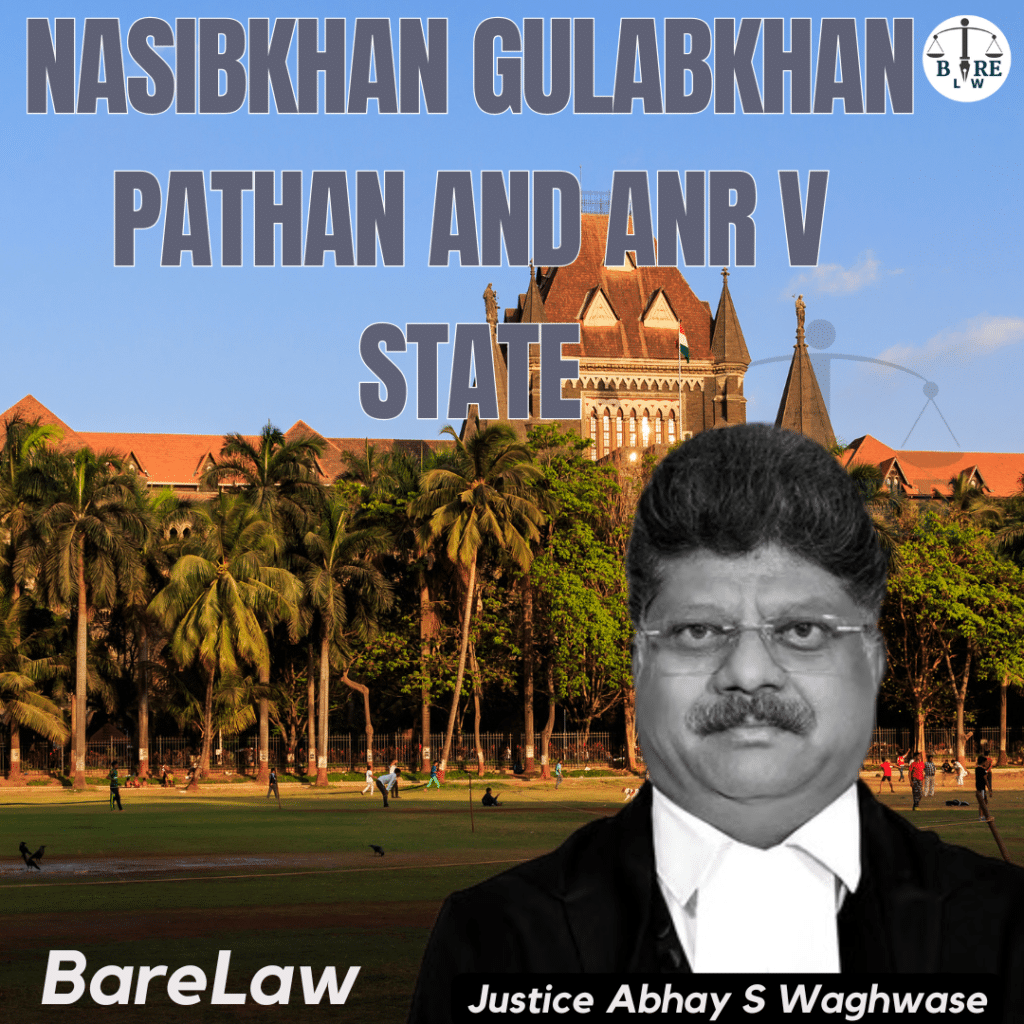
Nasibkhan Gulabkhan Pathan and anr v State
Bombay High Court acquits Assistant Public Prosecutor, law clerk in 22-year-old bribery case
In 2002, the complainant came to Judicial Magistrate First Class in Kallam alleging that APP in the case, Nasibkhan Gulabkhan Pathan, had demanded a bribe of ₹1,000 for the complainant to get a favourable outcome in the criminal case.
The complainant said the APP wanted payment to present the case in Court properly. After the complaint, the Anti-Corruption Bureau (ACB) laid a trap, and Pathan and his law clerk, Balasaheb Gunvantrao Yadav, were arrested.
Both accused were convicted during the Prevention of Corruption Act trial on September 29, 2005, before a special judge’s Court in Osmanabad. The appeal couldn’t be heard, however, as Pathan died.
The trial court convicted him, mainly relying on the testimony of the complainant and a shadow witness who is alleged to have seen the bribe demand. However, the complainant later retracted his statement, arguing that the allegations were fabricated and that he was forced to complain.
The retraction threw serious doubt on the prosecution’s case. But the trial court upheld the conviction, which prompted Yadav and Pathan’s heirs to launch appeals in the Bombay High Court.
They argued that the case against the accused did not have credible evidence. The defence pointed out that the complainant’s retraction made his testimony unreliable, and his account was inconsistent.
The shadow witness, who was also called into question, was not there when the bribe was allegedly demanded and gave contradictory testimony.
The defence further said that the prosecution’s sanction was invalid since the authority sanctioned it wasn’t in charge of the case when it did.
“The Court noted that the prosecution had not made out the case required by the justice above all doubt.”
The complaint, it said, combined with doubtful testimony by a shadow witness, raised a serious doubt about the allegations.
The trial court inferred that the case is proved beyond reasonable only on the evidence of PW2 shadow Pancha and some answers given by the complainant while under cross-examination by the prosecutor. Defence evidence and evidence of defence witnesses have not been considered while accepting the prosecution version, apparently. Hence, the High Court said, there is merit in interfering with findings recorded by the trial judge.
The shadow pancha’s evidence did not sustain the conviction when the main witness was hostile.
The Bombay High Court’s Aurangabad bench posthumously acquitted an Assistant Public Prosecutor (APP) who was accused of soliciting bribes to expedite legal proceedings [Nasibkhan Gulabkhan Pathan v Court of Maharashtra]
The Court also cleared a law clerk involved in the 22-year-old bribery case.
Justice Abhay S Waghwase also said there was no credible evideCourtn the case.
The Court stressed the importance of a fair trial and said there is ‘not a free from doubt prosecution case’.
The prosecution also faced criticism from the judge, who said he was ‘unconvinced’ there was much to the case and that the trial had ‘provided little by way of evidence’ concerning the sanction granted ‘mechanically,’ leading to serious questions about its validity.
The Court consequently voided Pathan and Yadav’s Prevention of Corruption Act convictions.
Nasibkhan Gulabkhan Pathan’s heirs were represented by advocates Mayur Salunke and VD Salunke.
Balasaheb Gunvantrao Yadav’s advocate, SS Panale, presented their case to the law clerk.
Additional Public Prosecutor Ashlesha S Deshmukh was present for the State.
Read more:
Skip to PDF content

Placing Penis On Vagina Is Penetrative Sexual Assault: POCSO
The Kerala High Court has clarified that placing a penis on a minor’s vagina after removing innerwear qualifies as penetrative sexual assault under the POCSO Act.

Gujarat HC on Live-in Agreements and Rape Allegations
The Gujarat High Court has ruled that when adults enter and end a live-in relationship through written mutual agreements, charges of rape on the pretext of marriage are hard to sustain.
Tu Hai Meri Kiran Halted: Bombay HC Contract Order
The Bombay High Court has stopped the release of the movie ‘Tu Hai Meri Kiran’ until co-producer Echelon Productions deposits ₹8.85 crore with interest, ruling that an Instagram collaboration cannot cancel written contractual obligations.

Supreme Court on ED Limits: Do Not Meddle With Other Agencies
The Supreme Court cautioned the Enforcement Directorate not to overstep its statutory boundaries or dictate how state police agencies handle shared information.