
Manu Bhandari v. Kala Vikas Pictures Private Limited and others
AIR 1987 Delhi 13
Primary Details of the case:
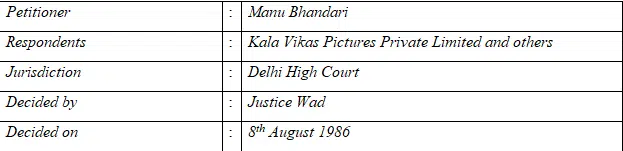
Manu Bhandari v. Kala Vikas Pictures Private Limited and others AIR 1987 Delhi 13
Introduction:
The first owner of a work that he has created is the author under the copyright law regime. An author can be an owner of copyright, but it’s not necessary that an author always owns copyright as well since it may be assigned to another person. That person shall possess ownership and copyright in the works. The conferment of copyright protection carries with him some rights. These include moral rights as well as those related to at least two types involving both the author’s right to have his or her work protected by copyright and moral rights in his or her name. On the other hand, this second type of right is not transferable, meaning that it remains with only one person who never cedes it to anybody else rather than the creator himself/herself. One such situation is presented in this paper which explored both issues that distinguish copyrights from moral rights and hence sparked controversy on these matters. The case involved.
The facts of the case:
Here are some events that took place in this case: As a plaintiff before us today, she happens to be an appellant who had authored a novel called “your Bunty.” She owned a copy right over this novel and then licensed its usage to Kala vikas pictures pvt limited company who are also known as defendant 1 here totally distort out of any truth that was contained within her book when they hired film director for movie ‘Samay Ki Dhara’. They prayed for injunctions stopping defendants (appellant) from showing or screening Samay ki Dhara movie permanently. No such previous decision was coming forward discussing about what extent does an authors’ right go till when should producer’s or directors’ right kick start? This motion was dismissed by my lordship sitting at trial court level because there were no prima facie evidence of distortion/mutilation in form of affidavit evidence submitted by plaintiff together with damages she suffered out her claim for interim relief quickly became nullity. Consequently, the appellant appealed to this Court. The issues and contentions are as follows.
Issues framed:
Whether the alterations made by the defendants were either not in conformity with the terms of the contract or any modification amounting to a breach of it under section 57 of Copyright Act, 1957?
Can an assignment by an author of his work to an assignee put an end to his right over the work?
Do directors have complete liberty to modify as long as they can while filming a novel written by other persons?
Laws involved:
Section 57:
This is about the special privileges of an author, but Moral rights of the authors are a marginal note under section 57. In this section, copyright protection given to the work sometimes forms part of author’s rights or may be separate from them. Consequently therefore , if there is any modification , mutilation , alteration and distortion that has occurred to the work which may prejudice author’s reputation he is at liberty to obstruct such changes or claim for damages.
Decision:
The Delhi High Court held as follows:
Firstly, the court likened its contract of assignment to be like one in s. 57 Copyright Act, 1957 concerning rights and remedies. It observed that those who assign contracts must read s.57 into their agreements with care so as not restrict them by any provisions connected with this statutory provision.
It then went on record regarding what modifications means under s.57 and stated that it does not imply that modifications for a film by the director can stretch thus far as perverting those modifications which modify everything shown in original novel.
After looking into various modifications, it held “that while making his screenplay for a movie out of one particular scene or more……….the painter was within his rights to express himself in presenting these scenes.” But this cannot mean ultimate destruction of or change of essential characteristics of book, as appears here; thus court emphasized maintenance both artistic treatment by writer-director and subject matter.
Analysis/Conclusion:
Having read the above case, it becomes very clear that section 57 provides a special right to an author of work even if the work has been transferred through a contract of assignment. Additionally, it includes redress where such works have been distorted or mutilated and in other ways prejudicial to either personality aspects about them.
Thus we can presume that there is an inviolability clause provided as part of section 57. The question arises who among the creators will own copyright on those works? This order is made in order to make money from such contract as it may have been the reason for assigning the work to film producer, and hence that economic right can only be given to a copyright owner. This leads us to an interesting question which remains unresolved, whether this court’s order conferring moral rights on author would take away some of the inherent rights of absolute property over the work that are vested in the copyright proprietor(s) like producer(s) and director(s) of the movie? Does that not curtail rules of ownership by statute?
However, the court observed that this had to be balanced against the moral rights and the absolute right of copyright owners; according to the court, changes should not offend an author’s personality or respectability.


