
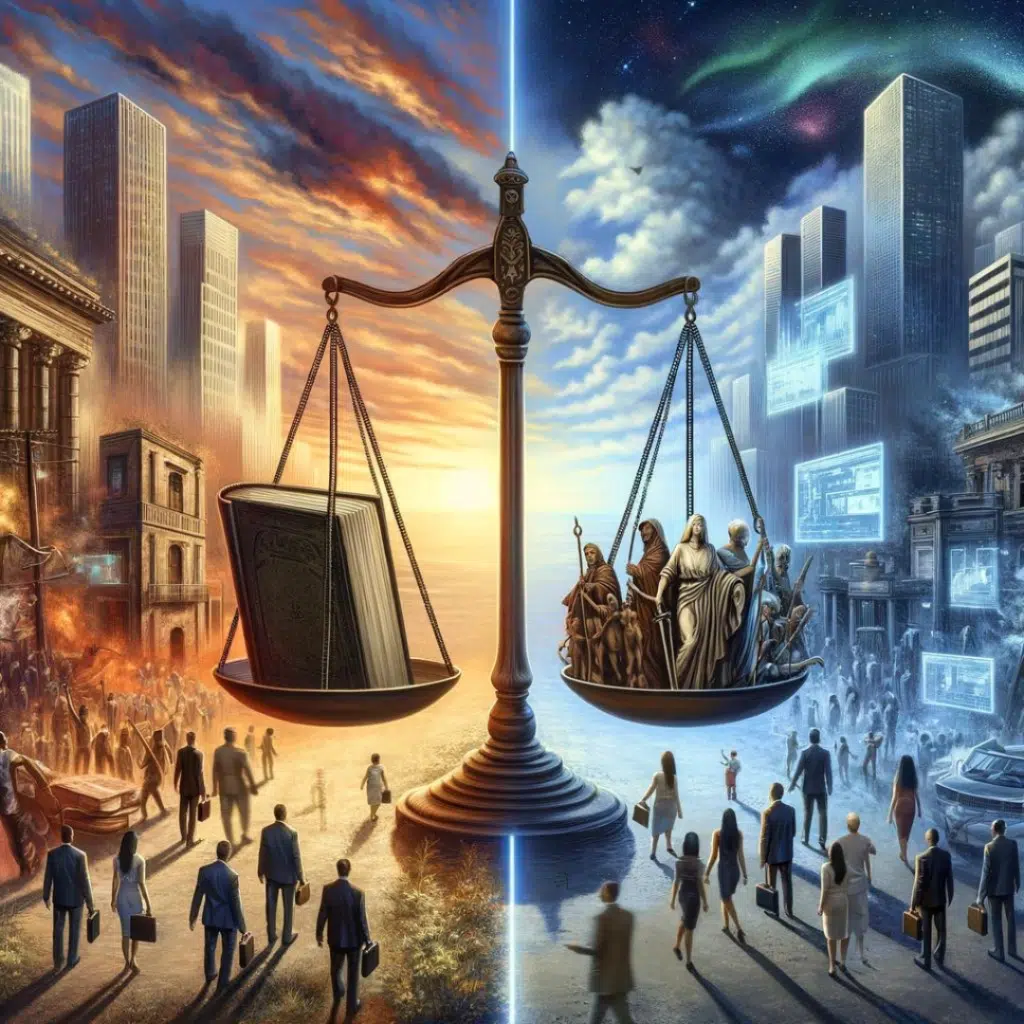
LAW AND SOCIETY: AN EYE-OPENING EVOLVING DILEMMA
Authored By – Adnan Ahmad

INTRODUCTION
When we talk about law and society they are considered two facets of a coin.
The performance of tasks in a human territory can only be done by the existence of the other.
Nevertheless, the existence of law is a prime requirement for an orderly and functional human culture.
It serves peace, justice, and equality. Even the most unprivileged sections of society feel strong and secure with the existence of a law in society.
The primary purpose of the law is to create a society based on solidarity, rational beliefs, and ethical values.
Most people tend to believe that law is a slow process based on inalterable standards not related to daily life but what they get wrong is that law is very dynamic it keeps on evolving with time and society.
So why it is important to analyze the relationship between law and society? A rational thinker may ask?
The answer to this dilemma is that both law and society impact each other.
Law being the product of society is the reason for social change.
On the contrary, the law is a reflection of the desires and needs of Society, and if you tend to study any society,
you must study the laws prevailing in that society.
In the current technology-driven world, laws created to meet global requirements are compelling societies to change accordingly,
it is an indication of a society heading towards development and when a society alters a law it’s a sign of wisdom.
German sociologist Niklas Luhman shares that law is an integral part of society further the States,
“All the collaborative human life is directly or indirectly structured by law, the law is more like a knowledge, an integral and universal fact for social change”
WHY LAW AND SOCIETY ARE INTERRELATED?
Law and society are both recognized jointly. A whole system can break down in the absence of any of them.
A society can turn into a wasteland without the operation of the law. So to keep pace the law must be changed through developments according to public requirements.
Law is embedded in all social institutions and socio-economic networks. These social elements affect the route of law towards legal change.
This is a result of personal and social interactions which can be very uncertain sometimes.
On the contrary, the law may itself change course.
For example, in India, the declaration of untouchability as unconstitutional is an attempt to change an old norm.
Still, it didn’t get much success due to a lack of social support. Thus there is a mutual relationship between law and society.
Furthermore, the law is binding on society and carries sanctions for those who don’t comply.
It is binding because people consider it to be. The law derives its obedience from the recognition it gets from those who see it as a compelling obligation.
It has been further observed that laws are often obeyed even if they are morally wrong.
For example, the mass genocide of six million Jews was carried out by people as a compelling obligation to the law which was one of the most horrific incidents in global history.
LAW AS AN INSTRUMENT Of SOCIAL REVOLUTION
Law being the product of society can lead to social revolutions. Generally speaking, there are two aspects to this theory.
First, is “Law transforming the society”, meaning that the legal framework of a country can compel a society to transform.
And second is, “Society transforming the Law” as per its wishes, meaning that a law can be changed as per the requirements of a society through its democratic institutions.
To understand it more clearly we can look into the reactions of people in the “Nirbhaya Case” indeed a most horrific instance of immoral acts.
This case shocked the whole country and it can be observed that even the most ordinary citizens of the country were talking about what the law should be and what kind of punishment must be given to the offenders.
This heated debate around the country compelled the government to accept the sentiments of the society and to create a commission to modify the existing law and ultimately the new amendment bill was introduced.
The wishes of the society can take the form of resistance shaking up the whole system which can compel a government to either reform law or create a new one or even repeal laws that are considered against society.
For example in Indian history when Savitribai Phule started teaching in schools to educate girls it was considered something bad and unnatural by society.
But this effort soon became a movement to educate and develop girl children. Eventually, society accepted it and also started sending their girl child to school breaking a long-time taboo.
Due to the efforts of the Phule couple and the social support, it got finally girls can study and even go to college.
Thus it can be rightfully said that “society transforms the law” as per its requirements rather than on command while the law also plays a vital role in transforming society.
ROLE OF THE INDIAN CONSTITUTION IN ACCELERATING SOCIAL CHANGE
The constitution of India was introduced by the framers to bring about the social transformation of Indian society.
The constitution enacted on 26th January 1950 includes a certain set of fundamental rights mentioned under Part III which serves its citizens certain rights necessary to bring about sociological change in the whole country.
For a long period, India faced exploitation and oppression at the hands of the British before it got independence,
so the Indian constitution was introduced as a supreme text exercising its authority over all the other statutes in the country.
The makers of the constitution made sure that no social aspect of any kind may be left behind from the protection granted by the constitution.
As can be recalled by the chairman of the drafting committee B.R. Ambedkar said that every aspect of the constitution can be amended to cope with the evolving society except for its basic structure.
This aspect has also been famously taken into account in one of the landmark cases of Keshavnanda Bharati v. Union of India.
The Indian constitution has been introduced to maintain a balance between individual freedom and social transformation and forms the soul of the constitution.
CONCLUSION
At the end of the discussion regarding how law evolves according to society.
It can be rightfully said that law is already an instrument of social change which affects society.
However still it’s a no-brainer that law must evolve in league with society to not become a hurdle in its development,
but this dilemma has not reached much success as we still have outdated British-era legislation which should have been deleted a long time ago, moreover such legislations also harm society at large.
Indeed both law and society have brought balance into the human domain but still, they have a very long way to go to achieve the required social change.
Also, read – https://www.ejiltalk.org/the-idealists-dilemma-re-imagining-international-society/