
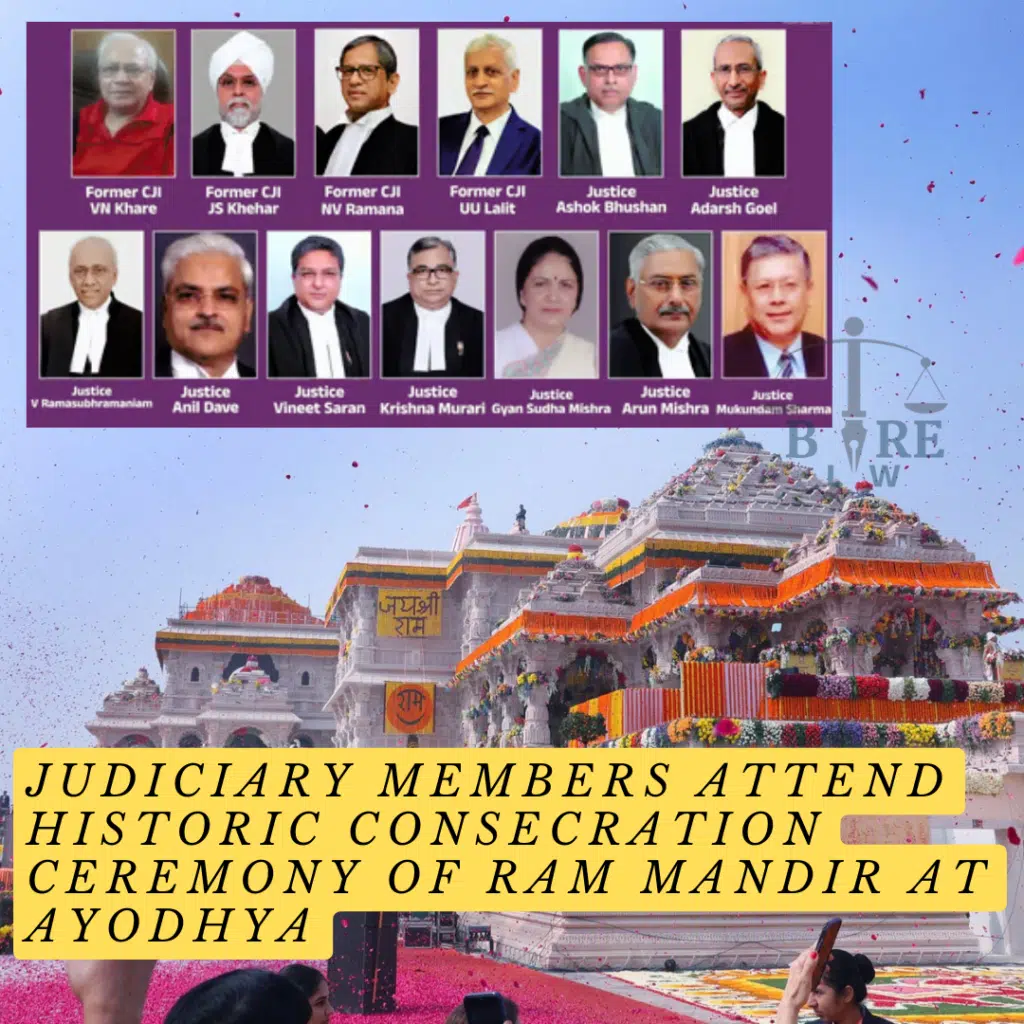
Distinguished Judiciary Members Attend Historic Consecration Ceremony of Ram Mandir at Ayodhya
The Historical Consecration of Ram Mandir at Ayodhya: A Momentous Gathering of Judicial Luminaries
In an event that marks a significant moment in India’s cultural and religious history, the consecration ceremony of the Ram Mandir at Ayodhya witnessed the attendance of an array of esteemed former judges from the Supreme Court. This gathering underscores the importance of the judiciary in the fabric of Indian society, especially in resolving complex and sensitive issues like the Ayodhya dispute.
Background: The Ayodhya Verdict and its Significance
The Ram Mandir at Ayodhya has been at the heart of a longstanding legal and cultural dispute. The Supreme Court’s landmark judgment in 2019, which paved the way for the construction of the temple, was a defining moment in Indian judicial history. It not only resolved a centuries-old conflict but also highlighted the role of the judiciary in upholding the principles of secularism and justice in a diverse nation like India.
Distinguished Attendees and their Contributions
The consecration ceremony saw participation from several former Chief Justices of India, including NV Ramana, UU Lalit, JS Khehar, and VN Khare, along with other retired judges such as Ashok Bhushan, Arun Mishra, Adarsh Goel, V Ramasubramaniam, Anil Dave, Vineet Saran, Krishna Murari, Gyan Sudha Mishra, and Mukundakam Sharma. Their presence at this event is reflective of their significant contributions to the Indian legal system and their role in shaping the country’s socio-legal landscape.
Notable Absences: A Sign of Ongoing Commitments
While the event was graced by many, some notable figures such as Chief Justice DY Chandrachud, Former CJIs Ranjan Gogoi and SA Bobde, and Justice Abdul Nazeer, who played a pivotal role in the Ayodhya verdict, were unable to attend due to prior official commitments. This highlights the ongoing dedication and commitment of these individuals to their official duties and responsibilities.
The Role of Judiciary in Indian Society
The attendance of these judicial veterans at the Ram Mandir consecration ceremony is not just a testament to their personal beliefs or inclinations but signifies the deep interconnection between the judiciary and the cultural ethos of India. The judiciary, in many ways, shapes and is shaped by the societal and cultural dimensions of the nation.
Conclusion: A Symbolic Moment of Unity and Justice
The Ram Mandir consecration ceremony, attended by such luminaries of the Indian judiciary, stands as a symbolic moment of unity, justice, and the culmination of a historical verdict. It reflects the harmonious coexistence of diverse beliefs within the framework of legal and constitutional provisions in India. This event not only commemorates a significant religious milestone but also celebrates the role of the judiciary in maintaining the delicate balance between different facets of a pluralistic society.
Summary: The consecration ceremony of the Ram Mandir at Ayodhya, a pivotal event in Indian history, was attended by numerous former judges of the Supreme Court, highlighting the interwoven nature of the judiciary with India’s cultural and societal fabric. This gathering symbolizes unity, justice, and the resolution of one of the country’s most enduring disputes, underlining the judiciary’s role in upholding secularism and democratic values in a diverse nation.
Barelaw, an online platform dedicated to delivering comprehensive legal knowledge, proudly presents its exclusive category of case briefs. This section is meticulously crafted to offer insightful analyses of landmark judgments, providing a valuable resource for legal professionals, students, and anyone interested in understanding the intricacies of law. Our case briefs delve deep into pivotal court decisions, exploring the rationale behind each judgment and its impact on the legal landscape.
We understand that navigating the complexities of legal judgments can be challenging. That’s why our case briefs are designed to be both informative and accessible, ensuring that readers gain a clear understanding of the key legal principles involved. Each brief includes a summary of the facts, the legal issue at hand, the court’s reasoning, and the ultimate decision. This structured approach makes it easier for our audience to grasp the nuances of each case.
Our website is a treasure trove of legal wisdom, constantly updated with the latest and most significant cases. Whether you’re a law student seeking to enhance your knowledge, a practicing attorney looking for a quick reference, or simply a curious mind eager to understand the law’s evolution, Barelaw is your go-to destination.
Explore our case briefs and immerse yourself in the world of law. Visit our website now and discover the wealth of legal knowledge at your fingertips. The link is provided below for your convenience and direct access to our expansive legal database