Internet and Mobile Association v. Reserve Bank of India
2020 SCC Online SC 275
Primary Details of the case:
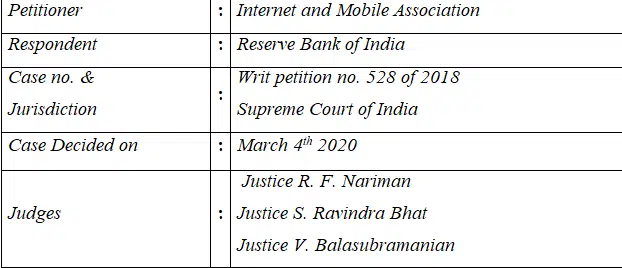
Internet and Mobile Association v. Reserve Bank of India 2020 SCC Online SC 275
Introduction:
The facts about this case were that with effect from 6th April 2018, an advisory was given by the Reserve Bank of India prohibiting regulated entities from providing services to any customers or individuals dealing with virtual currencies. Further another notice to this effect was also passed by the regulator during same year on June but ordered the whole world to never ever transact through any cryptocurrency channel neither should they render such bitcoin related services be it online or off line which was covered under provisions contained in various statutes like Sections 22(1), section 35A, section 36 (1)(a), and section 56 of the Banking regulations act, 1949; besides sections contained in the Reserve Bank of India act, 1934.
These statements were challenged through a writ petition under Article 32 stating that they are illegal and restrict all banking businesses including other financial institutions restricted by RBI from approaching banking facilities. Another petition was filed by members/shareholders/founders of several companies.
Facts:
The facts about this case were that with effect from 6th April 2018, an advisory was given by the Reserve Bank of India prohibiting regulated entities from providing services to any customers or individuals dealing with virtual currencies. Further another notice to this effect was also passed by the regulator during same year on June but ordered the whole world to never ever transact through any cryptocurrency channel neither should they render such bitcoin related services be it online or off line which was covered under provisions contained in various statutes like Sections 22(1), section 35A, section 36 (1)(a), and section 56 of the Banking regulations act, 1949; besides sections contained in the Reserve Bank of India act, 1934. These statements were challenged through a writ petition under Article 32 stating that they are illegal and restrict all banking businesses including other financial institutions restricted by RBI from approaching banking facilities. Another petition was filed by members/shareholders/founders of several companies.
Issues:
- Whether there exists any power vested in RBI to issue directions?
- If yes whether such powers have exercised properly and as laid down by law?
Laws involved:
- Article 19(1)(g) of the Indian Constitution – right to freedom of trade and business
- Section 22(1) – the power to issue directions along with a license to the regulated entities
- Section 35A – the power to issue directions in consideration of interested persons.
Contentions:
Petitioners:
- It was further contended by the petitioners that banking involves supply of oxygen more particularly when it come India Economy, as such denial on unreasonable grounds would amount to disproportionate use of firce by RBI and also access to services of banking is a part and parcel of banking business and any restriction thereof would curtail the right to freedom of trade guaranteed under article 19 (1) (g) of Indian Constitution.
- The Petitioners also submitted that an order made under an Act by a statutory authority will be inferior than an executive decision taken by Union Government. Thus, this order should be set aside for failure to act as per law.
Respondent:
- However, the counsel of Reserve Bank of India argued against the two matters. First and foremost, it was submitted that corporations like this petitioner cannot be treated as citizens of the country so they are not entitled to fundamental rights under Article 19(1)(g) of the Indian Constitution.
- Additionally, no right to sell, buy or even invest in any virtual currencies existed; hence article 19 should not be invoked.
Decision:
- Firstly, it was noted by Supreme Court of India that Reserve bank of India is more than a statutory body created by statute but has been seen as being its own maker at times and thus allowed for acts free from control by its foundational authority which is executive. The RBI exercises powers to issue directions on four main grounds: public interest; policy in relation to banking; protection of depositors; and interests of banks (section 35A read with section 22(1)of Banking Regulation Act,1949).
- The court then held a different view besides stating three major issues regarding RBI’s operations over the past five years. It listed out various points such as (a) whether there was any impact on economy and banking business due to growth in virtual currencies or not (b) lack of uniformity in regard to prohibiting or allowing VCs within our country (c) according to Inter-ministerial committee which drafted Crypto regulation bill in 2018 regulation should be bigger than ban on digital money.
- The court set aside Reserve bank notification dated June 6th 2018. It highlighted that RBI has special role especially with regards to nationalized banks’ regulation, non-nationalized banks’ regulation as well NBFCs and cooperative banks. None of these institutions suffered loss or were affected by VC s, therefore exercising power without adequate data invalidates such exercise. Therefore, Petitioners were allowed and notification was set aside.
Conclusion:
From the above case it is clear that RBI’s power of taking pre-emptive action such as cancellation of licenses of banks or issuing directions to other banks under the banking regulations act is conditional upon the manner in which the power is used. This means that unreasonableness in its exercise would invalidate any action taken by RBI. That was why despite its power to give directions, RBI’s 2018 direction was set aside due to the lack of data and reports of adverse impact of the ban on Virtual currencies. By reversing the 2018 notification, this case formed the basis for the Indian government’s primary action on regulating cryptocurrencies in India recently.