
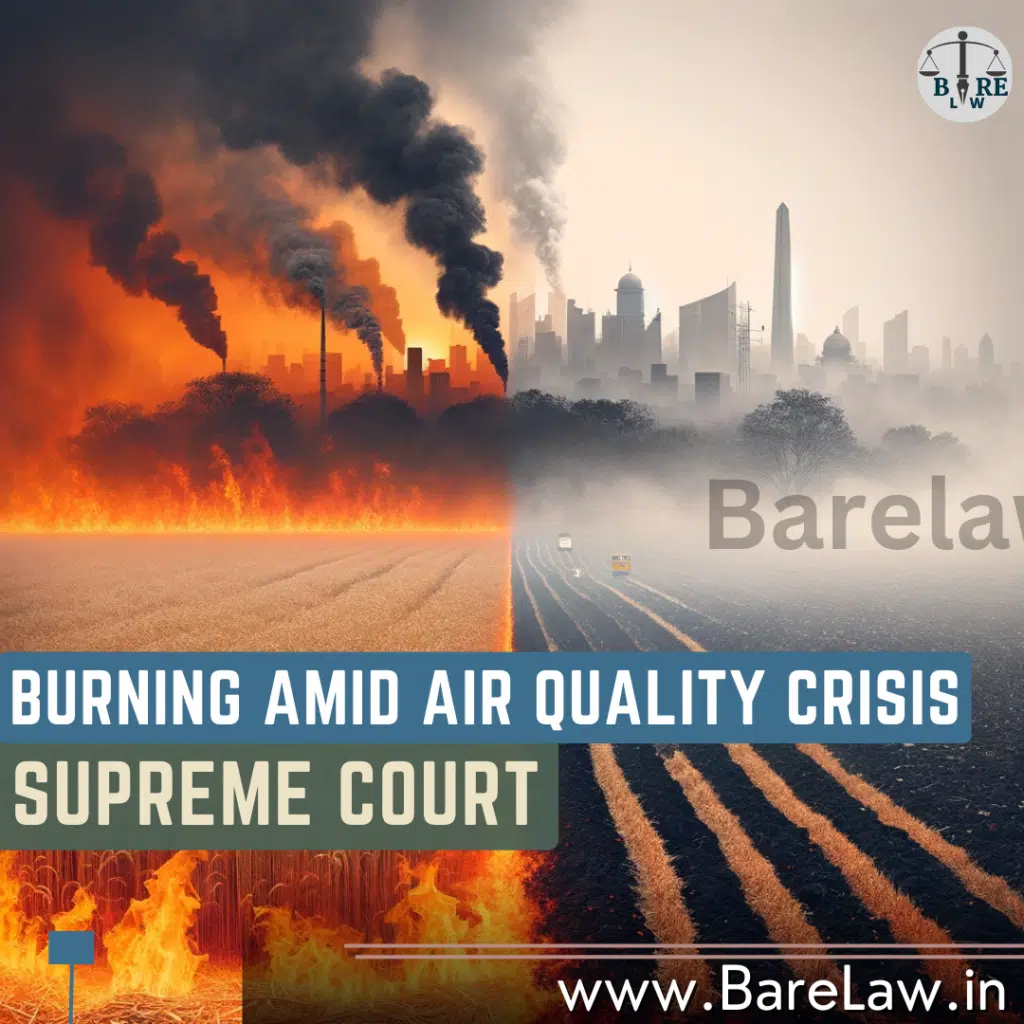
India’s Supreme Court Calls for End to Stubble Burning Amid Air Quality Crisis
In a significant development that underscores the environmental woes plaguing northern India, the Supreme Court on Tuesday issued a stark admonition against the practice of stubble burning by farmers in the states of Punjab, Haryana, and Western Uttar Pradesh. This agricultural practice has been identified as a substantial contributor to the air pollution that afflicts the region, including the national capital, Delhi.
The Division Bench of Justices Sanjay Kishan Kaul and Sudhanshu Dhulia voiced grave concerns regarding the hazardous air quality that residents of Delhi are forced to endure. Stubble burning, the method of setting fire to crop residue to clear fields for the next sowing season, has been recognized as an easy and low-cost option for farmers but with severe environmental repercussions.
While the Court acknowledged that stubble burning is not the sole perpetrator of the air quality degradation, it emphasized its significant impact. The apex Court’s message was unequivocal: the practice must be stopped to safeguard public health and environmental integrity.
During the proceedings, Justice Dhulia stated, “Stubble burning must go,” while Justice Kaul pointed out the substantial contribution of this practice to pollution levels. As an immediate measure, the Court has directed that local Station House Officers (SHOs) take responsibility for curbing stubble burning incidents, under the supervision of the Chief Secretary of the respective states.
The hearing also brought to the fore a potential solution involving the production of ethanol from paddy stubble as an alternative to burning it. The suggestion was noted by the Court amid discussions on environmental issues.
Advocate Aparajita Singh referenced an Air Quality Management (AQM) report which indicated that the incidence of fires due to stubble burning is a recurring annual issue. Senior Advocate Gopal Sankaranarayanan highlighted that the timing of the stubble burning and the choice of crop—paddy—in Punjab were exacerbating the crisis, contributing to the depletion of groundwater levels.
The Court did not shy away from critiquing the policy of providing Minimum Support Price (MSP) for paddy, linking it to the over-exploitation of water resources in the state. The observations made by the Court suggest a push towards a reevaluation of agricultural priorities, including the promotion of millets over water-intensive crops like paddy, which is not indigenous to Punjab.
This stance aligns with the Central government’s efforts to promote the cultivation of traditional crops and potentially indicates a shift towards revoking MSP for paddy to encourage this transition.
The Court’s deliberations are poised to continue, with the next hearing scheduled for November 10. The outcome could herald a significant shift in agricultural practices and environmental policy, with potential ramifications for the livelihoods of farmers and the health of millions.