Indian and Chinese Troops Exchange Diwali Sweets After Border Disengagement
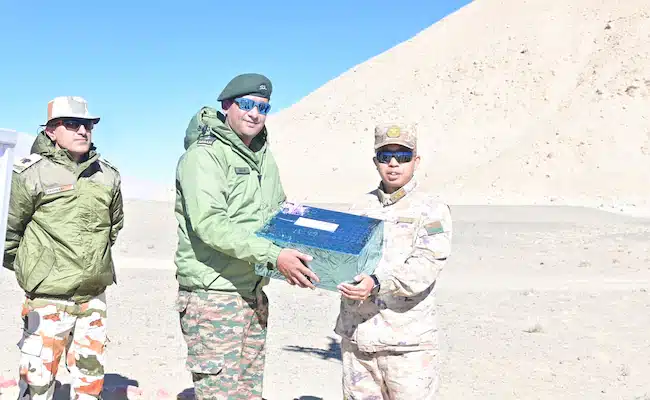
New Delhi: The Indian and Chinese military exchanged Diwali sweets at five points along the Line of Actual Control, including two in the Ladakh region. This comes a day after the two sides completed military disengagement from the Depsang and Demchok areas by last week’s patrolling plan.
Sweets have been exchanged at the checkpoints at Chushul Maldo and Daulat Beg Oldi in Ladakh, Banchha (near Kibutu), Bumla in Arunachal Pradesh, and Nathula in Sikkim.
According to the patrolling deal, the PLA expected to pull back troops and structures, including temporary buildings, from the Depsang plains and Demchok and troops withdrawal up to April 2020.
The deal should ideally resolve the nearly four-year-long military and diplomatic standoff resulting from skirmishes and violent face-offs in the Pangong Lake and Galwan River in May-June 2020.
These scuffles ranged from the killing of 20 Indian soldiers in Galwan in June.
Officials in the Indian army spoke to NDTV Wednesday. They said the verification process to ensure that China had, in fact, withdrawn its troops is still in progress. They added that ground-level commanders will inform the other side before regular patrols to prevent miscommunication. More notably, both Delhi and Beijing will each maintain a surveillance option in Depsang and Demchok.
The agreement was made on Monday of the week, and satellite imagery of the Depsang plains from the ‘Y’ junction the next Monday depicted four vehicles and two tents.
The second was captured on October 16, while the third was taken on October 20. The first set of images depicted dismantled Indian military tents and vehicles flying away, while the Demchok images revealed temporary Chinese structures absent by October 25.
“Trying To Restore Trust”
In the disengagement process, Army Chief General Upendra Dwivedi said that this week, the Indian military is “trying to regain trust in the Chinese side.”
“This (rebuilding of trust) will happen once we are able to see each other, and convince and reassure each other, that we are not creeping into buffer zones that have been created,” the General said.
Military tensions in the area shall be reduced after everybody issues a stand on the disengagement process.
External Affairs Minister S Jaishankar was reluctant to discuss timelines for de-escalation, stressing that a timeline would not be given unless Delhi was confident that its counterparts in Beijing would meet agreed commitments.
Halt remains an issue in other regions, such as the Gogra-Hot Springs region in the Union Territory of Ladakh, after Indian and Chinese forces pulled back in September last year. However, intel suggests that Chinese occupation of large parts of Indian territory to the north in the Depsang plains remains.
The importance of Depsang is viewed for India in terms that it was damn important as it gave Indian forces control over the airstrip at Daulat Beg Oldie, and Chinese hostile forces were seen constraining Indian logistics hubs in the region. While the Demchok is bisected by the LAC, the western side is controlled by India but claimed by China.
“After the issue deescalation strategy, how to handle the borders will be proposed,” he said in Mumbai.
The new India-China patrolling agreement was declared just a day before Prime Minister Narendra Modi’s trip to Russia to attend the BRICS summit, where he would meet his Chinese counterpart, Xi Jinping.
After the decision was announced, Mr Modi informed the Chinese leader, “We must work to have a stable border,” and singled out “confidence-building measures” that were based on confidence between individuals and confidence in individuals as the only way forward.