
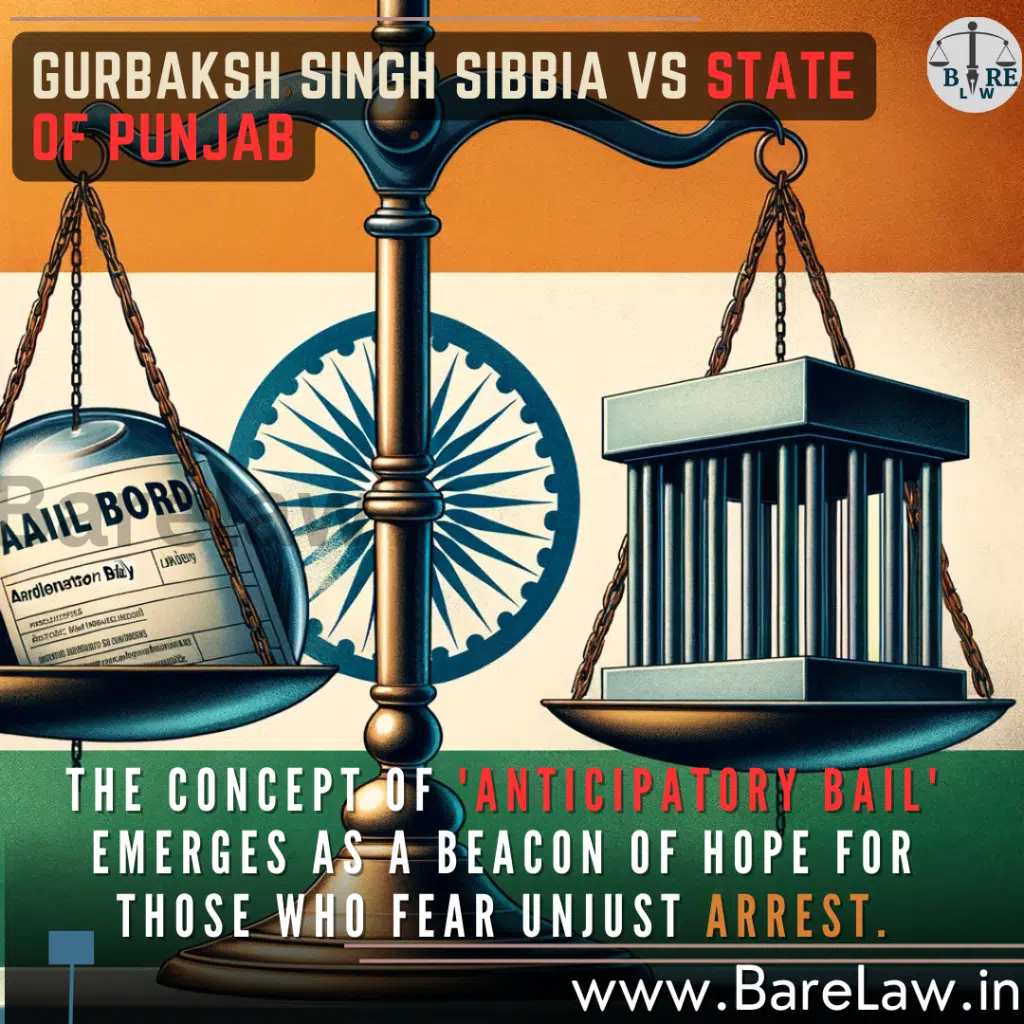
Anticipatory Bail: Insights from Gurbaksh Singh Sibbia vs State of Punjab
‘Anticipatory Bail’ is an enchanting term that materializes in the convoluted corridors of the Indian legal system reassuring those who dread being arrested unfairly. In India, the crucial case of Gurbaksh Singh Sibbia & Ors. vs. State of Punjab has been instrumental in comprehending and implementing Section 438 of Code of Criminal Procedure, 1973 (Cr.P.C.) which deals with anticipatory bail.
Understanding Anticipatory Bail
The judicial process through which an individual seeks for a bail before he is arrested is referred to as anticipatory bail. Even though it does not find a direct mention in the Indian legislations, it forms a part of Cr.P.C under Section 438. This section empowers the High Court or Sessions Court to grant bail where a person apprehends arrest for non-bailable offences.
Critical Perspectives on The Gurbaksh Singh Sibbia Case
The case under consideration involved Mr. Gurbaksh Singh Sibbia, then Minister in the Government of Punjab and others who were accused of corruption among other things Their application for anticipatory bail was initially dismissed by Punjab and Haryana High Court but was later allowed by Supreme Court This judgement laid down important guidelines for implementing section 438 which are meant to ensure that courts exercise their discretionary powers judiciously.
Guidelines from Supreme Court
Supreme court stressed that while granting anticipatory ball it should not be limited to ‘exceptional cases’ but it should be dealt with utmost care and caution. It further stated that there must be a “reasonable” threat to arrest, and held that there may be no absolute refusal of such relief even for crimes punishable with death or life imprisonment Additionally interim bails can also be given without notice to public prosecutor provided notice is sent subsequently.
Critical Perspectives
This ruling has been commended for striking a balance between individual’s liberty rights and need for effective investigation The Supreme Court has upheld the concept of justice and equal treatment before the law, by setting aside the restrictive approach of High Court in this context.
Implementing Anticipatory Bail: Suggestions for Justice
To curb anticipatory bail misuse, several measures like confiscation of passports, seizing accounts particularly in egregious cases, and making it mandatory for the accused to cooperate in the investigation process have been recommended. These are necessary checks that ensure that anticipatory bail is used as a panacea from unwarranted arrest but not as an instrument of escaping from justice.
Conclusion
The jurisprudence on anticipatory bail as expounded by the Gurbaksh Singh Sibbia case underscores that its application should be narrow-minded towards individuals. It serves as a legislative tool for protecting personal liberty while ensuring that the efficiency of legal system is maintained.