Table of Contents
Fresh Review Petition Challenges Supreme Court‘s Stance on EVM-VVPAT Verification
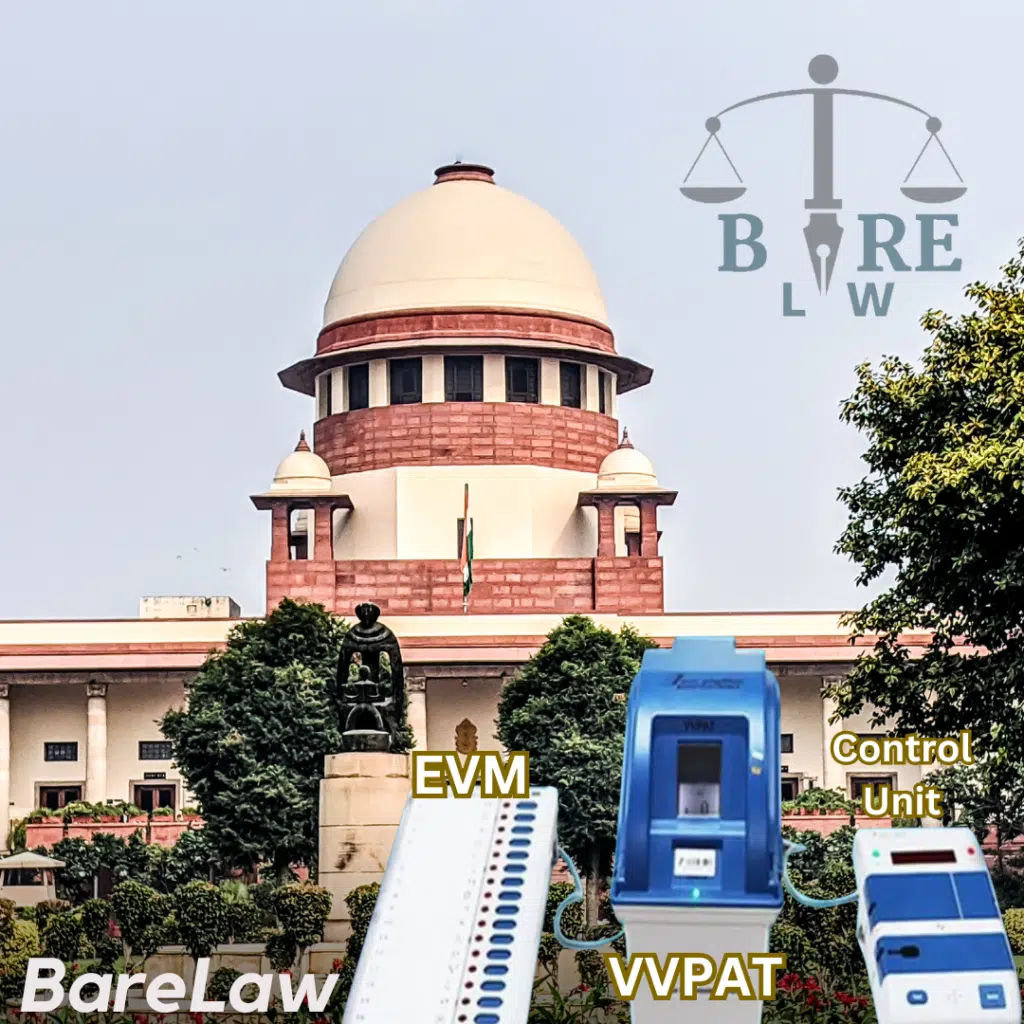
The electoral process debate in India which has now been transformed into a review petition in the Supreme Court against its earlier decision on the verification of ELECTRONIC VOTING MACHINES (EVMs) with VOTER VERIFYABLE PAPER AUDIT TRAIL (VVPAT) SLIPS, is a matter of transparency and reliability. This legal move, initiated by Arun Kumar Agrawal, the one who spearheaded the case, is designed to challenge the Supreme Court’s previous verdict which turned down the requests for 100% tallying of VVPAT slips with EVM votes.
The main argument of this review petition is complex, pointing out the key problems such as the possibility of counting all VVPAT slips within reasonable time frames and costs, the vulnerability of the VVPAT system, and the lack of the international platform to verify every VVPAT slip in accordance with the EVM counts after the Chandrababu Naidu judgment in 2019.
The petitioner states that the total verifying of VVPAT slips is not only physically possible but also financially feasible. He claims that by having a more efficient process and a small amount of extra workers, all VVPAT slips can be checked correctly in 5 to 8 hours, thus, increasing the credibility of the electoral process without imposing the excessive financial or temporal burdens.
The petition also raises questions about the trustworthiness of the Electronic Voting Machines (EVMs). The sentence shows that unlike paper ballots, EVMs do not provide voters the opportunity to check if their votes are recorded as they wish to. The inborn trait of electronic systems which includes the possibility of being hacked by insiders, such as designers, programmers, and technicians, is the risk that the petition wants to reduce by the VVPATs verification process.
The Supreme Court in its previous ruling, had described the simplicity, security, and user-friendliness of EVMs, and had underscored their contribution to the reduction of paper use and the alleviation of the logistical problems of the elections. Nevertheless, the review petition against this exists, that is for a system that does not only focus on the efficiency but also the trust and integrity of the electoral process.
Justice Dipankar Datta, in a separate opinion, pointed out the growing influence of the groups with vested interests which, according to him, are trying to weaken the nation’s achievements. This sentence shows that the narrative of the skeptics of EVMs not to mention the criticism has been pushed to the background by the fact that these challenges are driven by motives other than the transparency of the electoral process.
Conclusion
The review petition filed by Arun Kumar Agrawal is a vital moment in the continuous debate on electoral honesty in India. The Supreme Court, in this new appeal, will not only decide the future of the EVM-VVPAT verification method but also will be seen as a reflection of the judiciary’s ability to balance the technological innovations with the democratic safeguards. This case is a saw-awash for India’s pledge to the transparent, fair, and trustworthy elections, acting as a turning point in the development of the country’s electoral mechanisms.