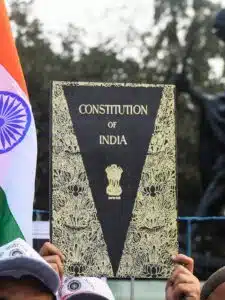
Freedom of speech and expression is a natural right of a boy by humans since his birth. These rights include the freedom to hold opinions and express them in front of the world. Article 19 (1) of the Constitution guarantees freedom of speech to the citizens of India subject to certain restrictions laid down in article 19 (2) of the constitution. The right to freedom of speech and expression is the essence of a democracy keeping in mind that the rights of other people should not be hindered.
What is freedom of speech and expression?
According to article 19 (1)( a) of the Indian Constitution, is the right to express one’s opinion and repudiation by any medium which may be oral, written or printed. It is thus the liberty of propagating ideas. It should be kept in mind that the propagation of one’s own ideas does not mean making irresponsible allegations on other citizens or government bodies. And therefore some necessary restrictions on freedom of speech and expression have been laid down in Article 19 (2) of the constitution. There can be affirmed that the right to freedom of speech and expression is not an absolute right.
Article 19 (1) of the constitution-
Article 19 (1) a of the constitution provides that every citizen of India shall have the right to –
(a) freedom of speech and expression
(b) form unions or associations
(c) assemble peacefully without arms
(d) move freely throughout the Indian territory
(e) reside in any part of our nation
(f) practice the profession of his choice
(g) carry on any business or trade.
Important facts of the right to freedom and expression-
(1) The right to freedom and expression is available only to Indian citizens and foreign nationals are not included.
(2) the right of freedom and expression extends to all the mediums of propagation i.e. oral, written, printed, depicted, filmed etc.
(3) The right to freedom and expression is not an absolute right and reasonable restrictions are imposed under article 19 (2) of the constitution in the interest of decency and morality.
What are the restrictions imposed on the right of freedom and expression and article 19 (2)?
Clause 2 article 19 lays down certain grounds on which the freedom of speech and expression can be restricted-
(1) State security
(2) Foreign relations
(3) Decency and morality
(4) Public order
(5) Defamation
(6) Contempt of court
(7) Sovereignty and integrity of India
(8) Incitement to an offence
Let’s go in-depth about these restrictions.
(1) State security – restrictions can be imposed on the right to freedom of speech and expression in the interest of state security. State security refers to security against rebellions, wars against the State etc.
(2) Foreign relations – The ground of foreign relations was added in the Constitution by the first amendment act of 1951. Reasonable restrictions can be imposed if the right hinders different relations with other states.
(3) Decency and morality – restrictions have been imposed on freedom of speech and expression in the interest of decency and morality under sections 292 to 294 of the Indian Penal Code. In the case of RanjitD. Udeshi v. State of Maharashtra (AIR 1965 SC 881), the supreme court prohibited the distribution, sale and exhibition of obscene words.
(4) Public order – the ground of public order was added in the Constitution by the first amendment Act 1951 arising out from the decision made in Romesh Thapar’s, case (AIR 1950 SC 124).
(5) Defamation – Article 19 (2) of the Constitution prohibits any person from defaming another person’s reputation under sections 499 and 500 of the Indian Penal Code. The only defence that can be taken here is the defence of truth.
(6) Contempt of Court – the right of freedom of speech and expression prohibits a person from contempt the courts. This was confirmed by the decision of the high court in E.M.S. Namboodripad v. T.N. Nambiar(1970) 2 SCC 325; AIR 1970 SC 2015).
(7) Sovereignty and integrity of India – This ground was added in the Constitution by the 16th amendment Act in 1963 to prohibit anyone from challenging the sovereignty and integrity of India
(8) Incitement to an offence – this ground was added in the Constitution by the First Amendment Act 1951 to prohibit a person from inciting people to commit an offence.
Is protesting legal?
The freedom of speech and expression protects protesting under article 19 (1) of the constitution as long as it does not violate the conditions laid down in article 19 (2). Hence, protest is a legal form of expressing dissent unless it becomes violent.
Conclusion-
It can be concluded that the right to freedom of speech and expression is an essential right and includes propagating one’s views through any medium subject to the restrictions mentioned in Article 19 (2) of the constitution. Therefore it is not an absolute right but plays a vital role in expanding the aforementioned rights to suit the needs of the current time.