
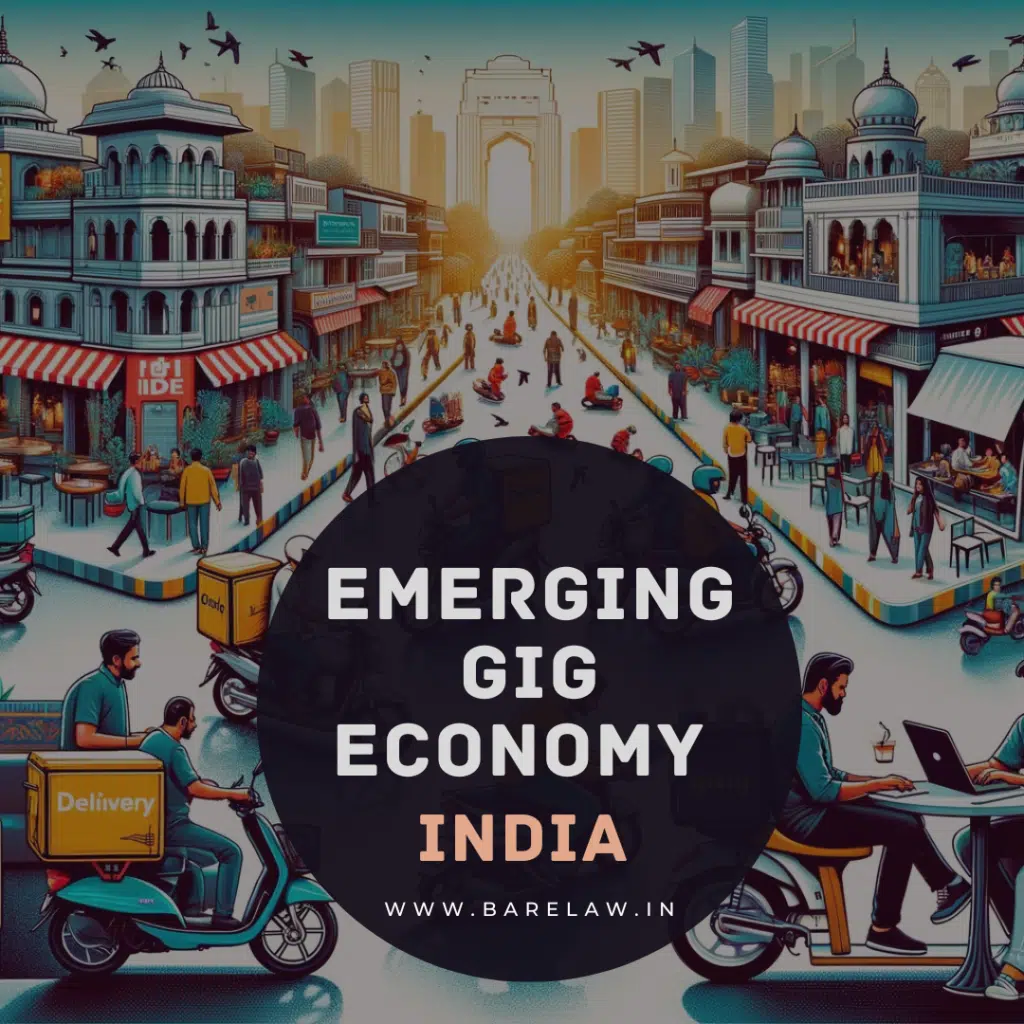
EMERGING GIG ECONOMY IN SPECIFIC REFERENCE TO INDIA | BareLaw
It is now apparent that the industrial and corporate sectors globally have been impacted by these technologies. In this respect, the tech sector’s industries including those in the corporate are well known for questioning the suitability of many laws in nations or between countries. A case in point is the platform works referred to as gig economy. There are also new challenges associated with such transformations though. The definition of gig economy is another challenge posed by this transformation to policymakers. The Indian scenario requires legislation to be enacted protecting rights of gig workers in India while at the same time guaranteeing them social security measures. This study will therefore consider whether gig work as a newly born phenomenon and its worker can be regulated by Indian labour laws given that it falls within informal sector of Indian economy since it seeks to understand economic impact and contribution of such gigs on Indian growth over the years besides highlighting issues about the gig workers market.
Gig Economy and ILO:
Let’s look at Gig worker as defined by International labor Organization (ILO). ILO identifies two types of jobs available for a gig economy: Microtasks – performed online can be called Crowd works since they are organized using global labor platforms on which every worker specify his or her capacity; services-enabled companies that require workers to do work using an app/website downloaded on their phones to perform tasks within a certain area- Delivery drivers, taxi drivers, Fast food workers fall into this category since their services are offered upon request. With all these classifications when it comes terms used to define them and what they represent might create ambiguity hence statistics would be key in defining who is part of the gig economy but not defining everyone within this classification.
Younger generation has experienced significant changes due to Gig economy as stated by ILO thus urging member countries to have effective policy frameworks that cover problems including Low profile works and paying less money for gig employees among other things.It should also take note that socially negative aspects of current emerging form of so-called gig economy, such as the lack of payment and the minimum wage, are combined with social protection measures that include minimum working conditions and hours of work, as well as other social security benefits for workers at both national and international levels. This was again pointed out by the Global commission on the Future work in the year 2019.
Gig economy in India
Gig economy has been in existence in India since the Indian economy began. They were around and they took different forms starting from the real estate and construction sectors which, are currently replaced by platform-generated works. Let’s first look at some statistical data to ascertain the number of people who are or will be part of Gig economy in India. The aim of this analysis is to establish how many persons are employed therein and it is then important that they too do not become victims of exploitation as usually happens with unorganized sector workers.
According to recent reports by Boston research and analysis, gig economics could grow in India and have potential to provide jobs for over 90 million non-farm industry workers across all sectors within India (Bhuyan, 2018). This economic growth has estimated a long run contribution of approximately 1.5% of India’s GDP (Bhuyan, 2018). A recent report on Gig Economy in India conducted a survey with various age groups involved regarding these workers and classified them under primary gig – those who chose this type of work as their occupation; secondary Gig – those who made another choice but also engaged in gig work; tertiary, any other person not forming part of gig economy as a whole. Some factors that need consideration have been outlined here:.
Issues and Challenges Ahead in the Gig economy of India:
However, there have been critics pointing out some issues and challenges even though there has been estimated economic growth that might come out from the gig economy in india (Hossain et al., 2020). Firstly, work assurance including such perks on other aspects like healthcare benefits and provident fund etc. According to Boston research, almost 20 percent of gig workers are dissatisfied with the gig economy primarily because it does not guarantee job security for them (Chopra et al., 2020). Those platform workers hired through gigs mostly suffer due to lack of job securities. This is because these workers will have their monthly.
In addition, as already discussed about the monthly earning section, another important thing to remember is that even though these employers through the platform are paid on a timely basis, employees have faced deductions due to different reasons such as penalties associated with delivery defaults against the rating customers value for any particular service on a given employee. For instance, in case Mr. A has been working as a freelancer for his employer on apps delivering food then even if he may not have done anything wrong like those individuals doing the deliveries. There was one incident where a delivery boy was abused in Bengaluru in 2021.Apart from reducing their pay check, all employers of gig workers may also decide to remove them from employment altogether. The regulators should consider a mechanism through which these disputes can be resolved by third party (regulators).
This issue is further compounded by another major issue related to reduced payments and this stands on the earlier issue of non-increment salary rates. In an ordinary company or industrial work, whenever there is an opportunity for increasing shareholders dividends, it means that their pays will increase because of inflationary period that may exist in market. This implies that your company looks at both your life style and background before giving you more money in terms of salary increments. In this platform or gig economy for instance; still most likely these opportunities won’t be available if companies become greedy over their staffs thereby making them work harder but paying less salaries therefore exploiting them.Therefore,the questions for policymakers would be about whether they want these conditions to impact heavily upon gig workers or need resolution sooner than later.
The next reason that tops among other causes of dissatisfaction by employers who employ them revolves around non-qualification and learning outcome from jobs done by such people. This however doesn’t imply absence of learning outcomes from job experiences of all persons involved in gig working.Data collected through interviews carried out with individuals found out competitive examination training providers who claimed to have learned while studying so they would write online and teach people.They are also available for those who have to gain education before they can take up gig works. The main issue here is whether these experience can be employed as part of a resume of any person if that is not upto the mark or not? These questions again, are to be answered only by the policy makers who shall be responsible for the future policy makings where gig economy will form a major part of the students and youngsters lives.