
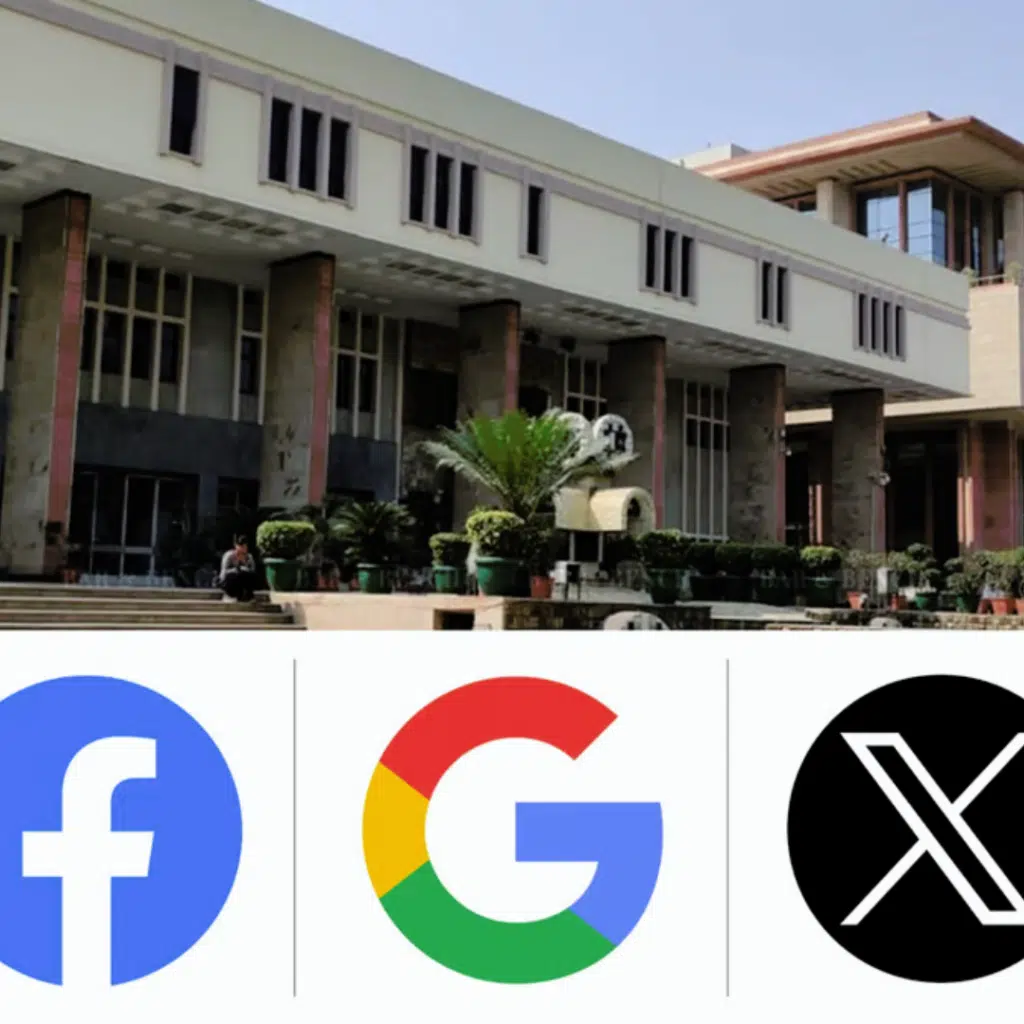
Delhi High Court Dismisses PIL Seeking Disclosure of Social Media Officers Coordinating with Government Agencies
Table of Contents
The Delhi High Court rendered a significant decision when it declined to order Facebook, Google, and X (formerly known as Twitter) to reveal the identities of their “designated officers,” who communicate with the Central government, law enforcement, and security agencies regarding issues related to national security, cybercrimes, and crimes against minors. In order to improve the effectiveness of addressing cybercrimes, particularly those against minors, and national security concerns, social media intermediaries and government entities must interact transparently, according to a public interest litigation (PIL) filed by former RSS ideologue KN Govindacharya.
The plea was declared without a significant basis by the division bench consisting of Acting Chief Justice Manmohan and Justice Manmeet Pritam Singh Arora. They pointed out that the ‘designated officers’ selected by intermediaries are meant to contact only with their government counterparts. The bench highlighted that the petitioner’s requests were unfounded because the government had not voiced any displeasure with the current arrangement.
The court further noted that the disclosure of the designated officers’ details by intermediaries is not required by Rule 13 of the Information Technology (Procedure and Safeguards for Blocking for Access of Information by Public) Rules, 2009. The bench came to the conclusion that the petition did not justify the court’s intervention for the proposed publishing of officers’ details because there were no complaints from the government over the intermediaries’ noncompliance.
The Information Technology (Intermediary Guidelines and Digital Media Ethics Code) Rules, 2021, which the bench claims meets the petitioner’s concerns, were also underlined by the court. The public is given access to a thorough grievance redressal procedure through the nomination of a Grievance Officer by intermediaries and the creation of a Grievance Appellate Committee under the 2021 Rules. This system handles complaints about the dissemination of potentially harmful news or posts and permits content regulation.
The Public Interest Litigation (PIL) aimed to enhance the transparency and accountability of social media platforms by contending that revealing the details of the authorized officers would expedite and improve cooperation between law enforcement authorities and social media businesses. The court’s decision to reject the request, however, shows how social media businesses have to strike a balance between complying with regulations and maintaining the viability of their business operations.
In court, Facebook defended its position by stating that it appointed an officer to oversee Central government directions, in accordance with Rule 13 of the 2009 Rules. Facebook has often complied with government orders without receiving any complaints, the business stated, and this officer does not deal with the public.
The court’s decision, which emphasizes that the procedures now in place under the IT Rules 2021 are adequate to handle the petitioner’s concerns, is a turning point in the continuing conversation about the connection between social media platforms and governmental authorities. The ruling highlights the judiciary’s strategy for making sure that the security, privacy, and efficiency principles are reflected in the regulatory framework for digital and social media intermediaries without placing unnecessary costs on the platforms.
In summary
The balance between operational functioning and openness in the digital sphere is highlighted by the Delhi High Court’s dismissal of the Public Interest Litigation (PIL) that demanded the disclosure of social media intermediaries’ designated officers. The court has reaffirmed its commitment to an organized approach in handling the intricate interactions between social media platforms, government agencies, and the public by relying on the framework and procedures already in place, which were established by the IT Rules 2021.
FAQ
What did the PIL deal with?
The PIL asked social media companies to disclose the identities of their “designated officers,” who work with law enforcement to combat cybercrimes, crimes against children, and national security.
Why was the PIL dismissed by the Delhi High Court?
The government has not complained about the compliance of intermediaries, and the court determined that the petition lacked a solid basis because the regulations in place do not mandate the publishing of such information.
What grievance redressal procedures are covered under the IT Rules 2021?
The IT Rules 2021 provide a strong mechanism for public grievances regarding digital material by requiring intermediaries to appoint a Grievance Officer and to establish a Grievance Appellate Committee.
Barelaw, an online platform dedicated to delivering comprehensive legal knowledge, proudly presents its exclusive category of case briefs. This section is meticulously crafted to offer insightful analyses of landmark judgments, providing a valuable resource for legal professionals, students, and anyone interested in understanding the intricacies of law. Our case briefs delve deep into pivotal court decisions, exploring the rationale behind each judgment and its impact on the legal landscape.
We understand that navigating the complexities of legal judgments can be challenging. That’s why our case briefs are designed to be both informative and accessible, ensuring that readers gain a clear understanding of the key legal principles involved. Each brief includes a summary of the facts, the legal issue at hand, the court’s reasoning, and the ultimate decision. This structured approach makes it easier for our audience to grasp the nuances of each case.
Our website is a treasure trove of legal wisdom, constantly updated with the latest and most significant cases. Whether you’re a law student seeking to enhance your knowledge, a practicing attorney looking for a quick reference, or simply a curious mind eager to understand the law’s evolution, Barelaw is your go-to destination.
Explore our case briefs and immerse yourself in the world of law. Visit our website now and discover the wealth of legal knowledge at your fingertips. The link is provided below for your convenience and direct access to our expansive legal database
You can access more legal drafts here – https://www.barelaw.in/legal-drafts/