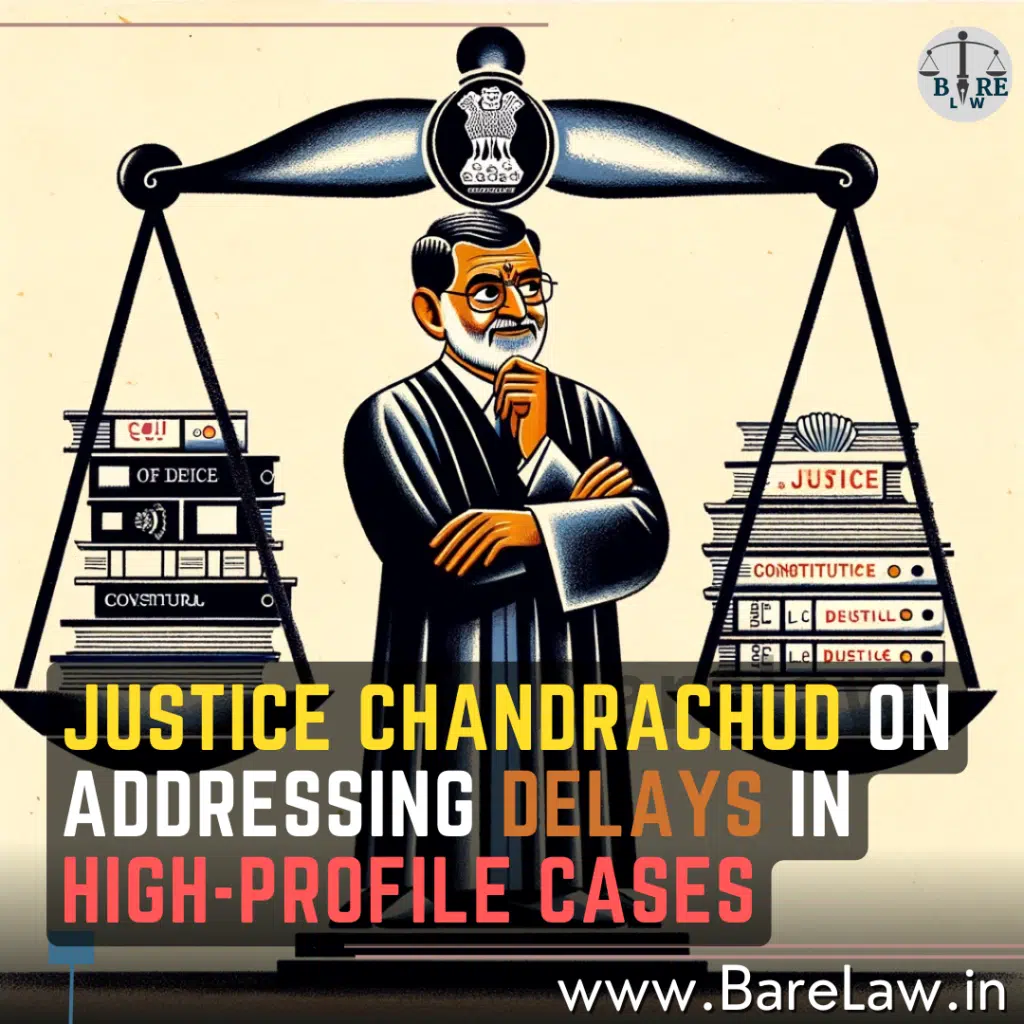
Balancing Act: Chief Justice Chandrachud on Addressing Delays in High-Profile Cases
In the intricate dance of justice, time is a partner that often leads with a challenging pace, particularly in the Indian judiciary system. The Chief Justice of India, Honorable DY Chandrachud, recently shed light on the delicate balancing act the Supreme Court performs in juggling politically sensitive cases and the daily grievances of individual citizens. This exposition came amid growing public and academic scrutiny over the postponements in high-profile cases, including the contentious Hijab ban and the abrogation of Article 370.
Chief Justice Chandrachud’s candid response was articulated during a recent discourse at Harvard Law School, where he expressed an acute awareness of the critiques while underscoring the judiciary’s broader responsibilities. The conundrum, as he describes, is not merely about prioritizing ‘big ticket’ matters of national substance but also about ensuring that the individual citizen’s access to justice is not overshadowed.
The logistical challenge of setting up Constitution Benches for pivotal cases is indeed formidable. Each such bench siphons judges from the pool of thirty-four, reducing the capacity to hear the myriad of other cases that are no less significant to the parties involved. When a seven-judge bench is constituted, for instance, the ramifications are far-reaching, impacting the court’s ability to dispense justice in other pressing matters, ranging from criminal appeals to bail pleas.
A vivid picture was painted by the Chief Justice, of a system stretched thin by volume and complexity. Unlike their international counterparts handling a couple of hundred cases annually, Indian Supreme Court justices are inundated with over 50,000 new cases every year. Establishing multiple Constitution Benches, therefore, means significantly reducing the number of available judges to address this massive inflow, a decision not taken lightly by the head of the judiciary.
In a thoughtful move to counter the critiques and improve efficiency, CJI Chandrachud has initiated steps to have a Constitution Bench in operation throughout the year, ensuring that matters of constitutional importance are not left in limbo. This is a strategic shift towards a more dynamic scheduling system, potentially offering a partial solution to the backlog conundrum.
However, it’s not just about the numbers or the organization of benches. At the heart of Chief Justice Chandrachud’s address is a philosophical contemplation of the Supreme Court’s role as a court of appeal. The apex court cannot afford to lose sight of either side of the judicial coin; while creating space for substantial matters is crucial, it is equally imperative to uphold its duty towards individual appeals.
The judiciary’s task of balancing cannot be understated, and the Chief Justice’s transparent acknowledgment of the challenges and his forward-looking approach offers some reassurance. It’s a testament to the dynamic nature of justice — adaptive, considerate, but above all, committed to equity and fairness for every citizen, irrespective of the scale of their case.
While the steps taken may not instantly dissolve the backlog or appease every critique, they mark a conscious effort by the judiciary to evolve and accommodate the ever-changing demands of justice. The Indian Supreme Court, led by CJI Chandrachud, stands at a pivotal juncture, where every decision is a step towards refining the scales of justice to balance the colossal weight of a nation’s grievances and its constitutional quests.