PRIMARY DETAILS OF THE CASE:
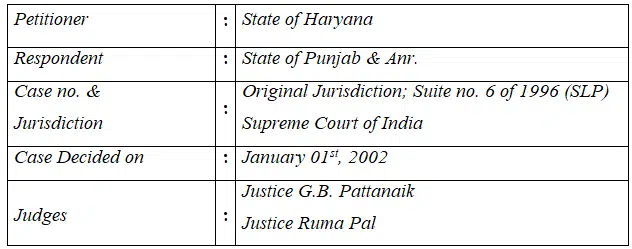
Case brief on the state of Haryana v. State of Punjab & anr.
Introduction:
India is not new to interstate disputes. Water sharing was just one among many other issues that would crop up between states in India. A case in point would be the northeastern states’ borders dispute. In terms of river water sharing, there are numerous states which claim interest over it, beginning with Tamil Nadu – Karnataka & Kerala up to Punjab-Haryana.There are several challenges for each of these issues. Supreme Court’s jurisdiction was a major bone of contention in all these matters due to existence of Inter-state tribunals for each aspect and article 131 of the Indian constitution allows for the Supreme Court’s intervention into cases arising between two or more States or between Centre and States as provided by this provision.
In this regard, one such issue arose in the following case involving the State of Punjab on one hand and on the other hand …
This article will give a brief insight into the case ‘State of Haryana v. State of Punjab & Anr.’ (2002).
Facts:
The facts were that petitioner in this suit is state of Haryana who had filed suit against state of Punjab and Union Of India praying that mandatory injunction order be given in favour of plaintiff against agreement entered by them; The issue here was about building and sharing Sutlej-Yamuna canal through it. They made an agreement with each other concerning construction on SYL Canal through which both states planned to share their waters between them.It slowed down later because construction took place within Punjabi territory thereby denying petitioner water totally under this treaty.He wanted both parties to meet through Union Of India so as its meeting can take place at faster rate but due to impositions such as president’s rule there has been no government since then.A white paper issued by a state revealed that they did not want to construct canal and instead use old Bhakra canal earlier completed by them & divide waters accordingly It was considered totally impossible as well.This petitioned Haryana State to move the Supreme Court under Article 131 of the Indian Constitution against both Union government and State of Punjab over division of river waters as per agreement.They prayed on two main grounds, that is; i) to render this agreement valid and binding upon Punjab state as early as possible, ii) to make a mandatory injunction for performance between them according their notifications. Issues framed with this matter are as follows
Issues:
Some important issues were in this case that will be determined by the supreme court of India.
Firstly, whether the petitioner should be entitled to any relief against the state of Punjab as prayed in the petition or not?
Secondly, whether suit filed shall be maintainable or not as contended contrary by defendants in their written statement?
Whether has this particular suit filed under limitation taken a place or not?
Laws involved:
Section 78 of the Punjab Reorganization act of 1966
Article 131 of the Indian Constitution:
Exclusive original jurisdiction of the Supreme Court in disputes arising between centre and state or between states or union and more states.
Contentions:
As concerns to subject-matter jurisdiction, defendant in this case – State of Punjab and Union Government contended that ‘present matter’ fell within scope and applied accordingly Inter-state water disputes act of 1956. So that according to section 11of the said act, 1956 along with article 262of India’s constitution, Supreme court shall be barred from hearing it.
Punjab also raised objections regarding the order passed by Ravi-Beas tribunal after its creation in respect to agreement entered into between them in1976.
The same has not been dealt with by a tribunal so far which is why application filed under section 5 of interstate water disputes act cannot be taken as anything until and unless decided. Hence, it was firmly submitted that only Tribunal should dispose of the matter.
Lastly, it was contended that the plaintiff in this case-state of Haryana would not have any right to invoke article 131of Indian constitution and argued that time would bar the matter itself.
Conclusion:
Three main issues were before the Supreme Court which are as follows;
Firstly whether or not Alternatively, when considering whether this case can find its way before a tribunal; it should have been established if canal construction is comprised within water dispute. While determining same, it clarified that referral for all other matters concerning such an agreement could be done through tribunals under Punjab Act. However, it took a contrary view holding that building canal is never considered as dispute related to river among different states. This law-making body indicated during enactment involved no dispute about what constituted a “water” issue for purposes of section 2 of the Interstate water dispute act, 1956. Thus, the question of maintainability and reference to tribunal was answered by saying that canal construction in this suit does not amount to water dispute and will not be referred to Tribunal. It also said that Supreme Court is none other than a bar against it under article 262,of Indian Constitution, coupled with section 11of Interstate Water Disputes Act, 1956.
The Supreme Court left the applicability of limitation act unanswered specifically because Punjab did not stress much on the same. This too went in favor of Plaintiff.
Finally, considering whether mandatory injunctions would be issued or otherwise, the court found that convening meeting between states and union of India; one cannot allow these parties withdraw from such meeting or make any other contrary decisions whatsoever on things agreed upon between them. Therefore, the deal must stand.