
Primary Details of the case:
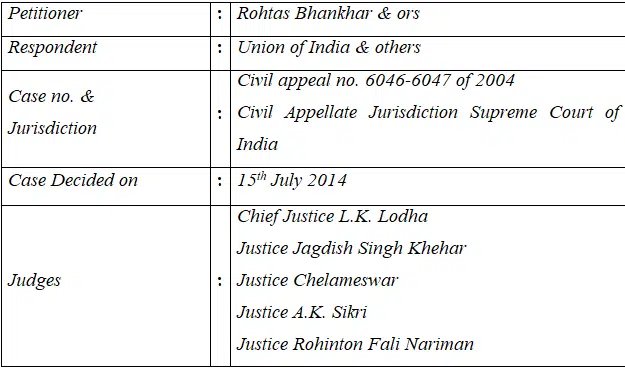
Case Brief on Rohtas Bhankhar & Ors v. Union of India & Ors
Introduction:
This case is just a reiteration of what was already held in the earlier decisions in both Indra Sawhney and Kuldip Singh cases. Both of these cases have underlined the importance of article 16 as well as 16(4A). The issue whether reservations for promotions in services are obligatory or mere enabling discretion in the hands of the Government has been addressed in this case. Case Facts
Facts of the case:
In 1970, an office memorandum was issued by Department of Personnel to relax the standards for Scheduled Tribes and Scheduled Castes candidates in respect of departmental competitive examinations and also confirmation examination. It is stated that this particular Office Memorandum was enforced for approximately 17 years and it subsequently got withdrawn by issuance of another memorandum by the department in the year 1997 which led to amendment to Central Secretariat Service Officers’ Grade/Stenographers’ grade (Limited departmental examination) regulations, 1964 resulting into Central Secretariat Service Officers’ Grade/Stenographers’ grade (Limited departmental examination) regulations, 1998. This amendment omitted operation of regulation 7(3) from 1997 onwards. These changes were brought about by central government subsequent to judgment dated february1/2001 passed by Hon’ble Supreme Court wherein while holding that relaxation made in criteria for ST/SC candidate was not valid but my Lordships did not make them un-enforceable, instead they made them non-operative hence enforceable against him.
Finally, appellants pray before this Court seeking declaration that order dated July10/97 is ultra vires.
Issues:
The Supreme Court of India framed the following issue in this case, which has also been referred to it by the three-judge bench.
Whether authorization given to Respondents No.2 &3 herein (Central Government and Department Of Personnel), by way whereof they were competent to apply a lesser standard required for promotion on SCs/STs than their counterparts General Category or not?
Laws involved:
Article 16(4) – empowers the State to make reservations in public appointments in favour of SCs/STs if the State feels that they are inadequately represented in government service.
Article 16(4-A) – reservation for SC/ST SCTs if the state is of the opinion that they are not adequately represented in Union or State Services.
Contentions:
Contentions made by the appellants and respondents before Delhi Administrative Tribunal may be stated as under.
Appellants primarily relied on the plain text in article 16(4A) of the Indian Constitution which deals with SC/ST reservation in promotions. They also relied on 1998 Ram Btiagat Singh case where Supreme Court of India has allowed lowering qualifying marks for SC/ST candidates without affecting the efficiency required by the job. In that particular case, appellants cited a mark reduction from 55%. Secondly, they also relied on Kuldip Singh’s observation made concerning how important article 16(4A) was introduced to Indian constitution and why such duty resulted from article 46 of the constitution (protecting the interest of SC/STs and preventing social injustice).
However, respondents argued that according to Indra Sawhney case law any law would become effective commencing from when decision will have been pronounced by supreme court overruling all previous circulars contrary thereto. Thus, after declaration of result in 1998, this is when it will delete proviso to rule 8 as contained in limited departmental examination regulation, 1998.
Decision:
Two main things were considered by court while deciding upon this matter.
In first place it looked at how important is article 16(4A) thus confirming what had been earlier said in Nagaraj’s case. It was stated therein that these constitutional amendments did not alter preceding structure under sub-clauses 4A and B added into Art.16 because they are meant only to provide necessary factors like backwardness or no adequate representation in state posts: hence state must provide reservation for such candidates on this account alone. Only SC and STs fall within this boundary line.It was observed too that State is not obliged to maintain reservation for these categories elsewhere than at least conceptually elucidated creamy layer ceiling limit variability and fifty percent. In view of this, Supreme Court has held equality under Article 16 can crumble if requirements such as 50% limit and compelling reasons for making reservations are not there.
Secondly, the answer to the extent of reservation is found in reference to Kuldip Sigh case where state’s power to provide reservation regarding promotions was discretionary rather than mandatory. The discretion will be exercised by the government only when there are sufficient grounds for them to reserve promotion posts. However, the new reservations ought to also avoid going beyond a ceiling fixed at 50% or include creamy layer as was established in Indra Sawhney case.
They ended by setting aside impugned order of 1997 and declared administrative tribunal’s decision nullity on the authority of Vinod Kumar case. Therefore, an appeal was allowed.
Conclusion:
Based on the above case, it is evident that article sixteen did not change its original purpose after the amendment. Reservation in promotions in state services has been regarded as an enabling provision of law and should be exercised only when there are sufficient grounds to do so.