Primary Details of the case:
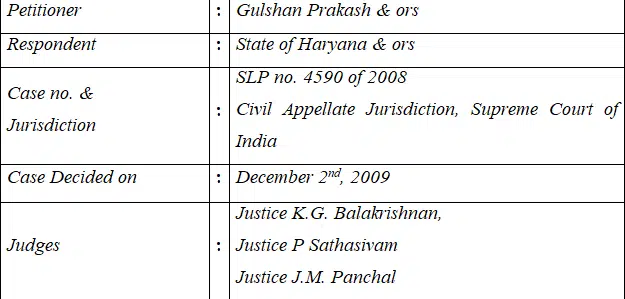
Case Brief on Gulshan Prakash & Ors v. State of Haryana & Ors (AIR 2010 SC 288)
Introduction:
The Indian Constitution establishes a system that protects the rights of its citizens wisely. Besides, some of the rights are to be ensured by states through legislative enactments and regulations which would meet the needs of all categories of persons equally. However, it should never be used as a tool to destroy the system especially in relation to reservation. In this case, the power to provide the reservation or not for that matter has been reiterated as vested in the hands of the state alone and they will decide accordingly. The facts and issues are stated hereafter.
Facts of the case:
That in 2007, State of Haryana issued a notification notifying Maharshi Dayanand University Rohtak as conducting entrance examinations for admission to various courses like MS/MD/ PG diploma and MDS etc.,in government medical colleges and dental colleges situated in Haryana State.This notification was for 2008-09 involving declaration of results for such entrance examinations also instructing Pt B.D Sharma PGIMS Maharishi University, subsequently after such entrance exams i.e., to do counseling process , fix/select list of candidates for these courses.Aware thereof , Maharshi University also conducted said exams from 2008-09.In 2007 appellants herein had approached respondent no.s1 and 2 i.e., Health Ministry & Government Of Haryana at Panchkula with regard to implementation of reservations in P.G.Courses mentioned above according to Government guide lines.No response having come forth from respondents, petitioners filed a writ petition before High Court which was dismissed.Such an appeal is preferred by appellants before this Hon’ble Court under Article 136 by way of Special Leave Petition.Issue:Issues are framed as follows.
Issues framed in the case:
Two main issues raised in the above case are,
Whether a writ petition can be filed before Supreme Court of India directing concerned state government to implement SC/ST reservation on basis articles 15 and 16 of Indian Constitution or not?
Can the court fix a minimum qualifying mark for the candidates in the reserved category, especially for post-graduation in Medical education or not?
Laws Involved:
Article 15(4) – Power of state government to make any special provision for advancement of socially and educationally backward classes including S.C./STs.
Article 16(4) –gives power to the state to provide reservations in public posts to those persons from SC/ST if they are not adequately represented in public services.
Contentions:
Appellants say that Maharshi University has made reservations in the P.G. Medical courses as per its notification of 2000, and also various medical colleges in Haryana including AIIMS provided reservation to Post Graduate MBBS courses in the State of Haryana. The appellants have so mentioned reservation by Delhi University, College of Dental Surgery, Safdarjung Hospital and some other medical colleges of New Delhi. They have also relied upon seven judge bench judgments rendered in N.M.Thomas case wherein there was no reference relating to reservation to S.C./STs in medical courses particularly P.G.Medical courses and whether they mandate the state to provide compulsorily or not.
On the contrary, the respondent state had argued on three major grounds that are most valid. First, they submitted that certain backward classes were already reserved by Haryana State itself. Second, article 15(4) is nothing but an enabling clause which does not mandate states for providing reservations for Scheduled Tribes, Scheduled castes and Other Backward Classes among their postgraduate candidates respectively. In such a situation therefore, it was heavily contended that through writ petition of Mandamus the state should not be compelled to make reservations to this category of persons.
Decision:
On the first issue however Supreme Court reiterated its views made from time immemorial concerning article 15(4). It held as follows,
Firstly, it indicated that there was nothing wrong with what state governments did when they did not do any reservation. It pointed out that while deciding necessity under Article 15(4), it must be understood that only State government shall be best judge for providing reservation for Scheduled castes,scheduled tribes and OBCs too .It accepted respondents contention that Article 15(4) is just a mere enabling clause to states though it would take any decision on this aspect.Just because a particular State has made provision for reservations at Undergraduate level does not mean that it must mandatorily make a reservation at P.G. level also. Thus, the court affirmed the contentions of the state of Haryana as it firmly decided not to make a reservation ,and such a decision shall never be questioned on the ground of issuance of a Writ of Mandamus. Court also suggested that in future if required, state is free to reconsider its stance.
Secondly, on whether minimum qualifying marks should be fixed to Scheduled castes and tribes or not, the court referred to Preeti Srivatsava case and said that there should not be any disparity between marks for general category candidates and lowered marks for reserved category in an unreasonable manner. It will amount arbitrariness in such cases and therefore fixing marks has relation with qualification of these professional studies which calls intervention by Medical Council of India (M.C.I.). Fixing percentages like 45% & 20% for general category and reserved category respectively would contradict each other besides being against public interest.
Conclusion:
This reasoning by the court, however, overruled the idea that reservation should not spoil merit system in education. An arbitrary process would lead to a degradation of educational merits. States have to look into it and decide (whether they want to give reservations or not) so that justice is seen to be done in society.