INTRODUCTION
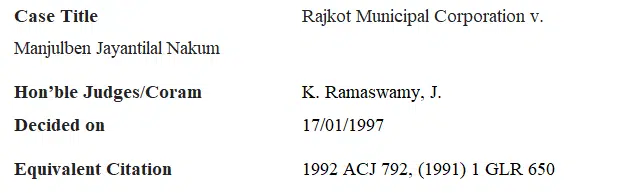
CASE IS ABOUT
Table of Contents
Know about the Case brief of Rajkot Municipal Corporation v. Manjulben Jayantilal Nakum
In the Rajkot Municipal Corporation v. Manjulben Jayantilal Nakum case, the court determined that there cannot be a tort claim if proof of the contract is required. Although the plaintiff might have also pled in the contract, a tort action would be proper if the claim stems from the relationship between the parties rather than the contract.
BACKGROUND:
Due to Rajkot Municipal Corp.’s (the appellant in this case) negligence, the husband and father of the Jayantilal respondents passed away.
FACTS:
- Jayantilal was killed when a wayside tree suddenly fell on him while he was walking to his office. The Corporation was sued by respondents for $1 million in damages (appellant herein).
- The trial court found that Corporation was responsible for Jayantilal’s death since they did not fulfil their legal obligation to inspect the tree’s health, and they were ordered to pay 45k.
- Corp appealed to the HC. The Corp. was also found responsible by the Division Bench because the Corp. was negligent in failing to take the necessary precautions to protect the deceased’s life, which gave rise to Tort Liability under the law. The company neglected to regularly check the health of the trees.
As a result, the Corporation appealed for special leave.
CONTENTION:
The HC’s assertion that the corporation has an unqualified and absolute duty to maintain trees is incorrect.
It was understandably impossible to check every tree for health, and it was impossible to foresee a tree falling suddenly as Jayantilal was passing.
The doctrine of the neighbourhood as established in Donoghue v. Stevenson is not reasonably close to the obligation of care.
LEGAL PROBLEM:
Will there be a tort action if the claim requires contract evidence to be proven?
JUSTICE K. RAMASWAMY, RATIO
The Corporation was instructed not to recover $45,000 because the respondents were in need.
There was insufficient proof of causation since it was difficult for a normal, prudent person to rationally predict the harm that would result from the defendant’s carelessness or causation in the performance of the obligation.
The respondent failed to adequately establish the neighbourly relationship and close proximity of the negligence in this case.
Also, Read – https://lawplanet.in/rajkot-municipal-corporation-v-manjulben-jayantilal-nakum-case-summary-1997/