Table of Contents
Bhuvaneshwar Prasad Sinha: India’s Chief Justice Who Shaped Legal History
Bhuvaneshwar Prasad Sinha: India’s Chief Justice Who Shaped Legal History
Introduction
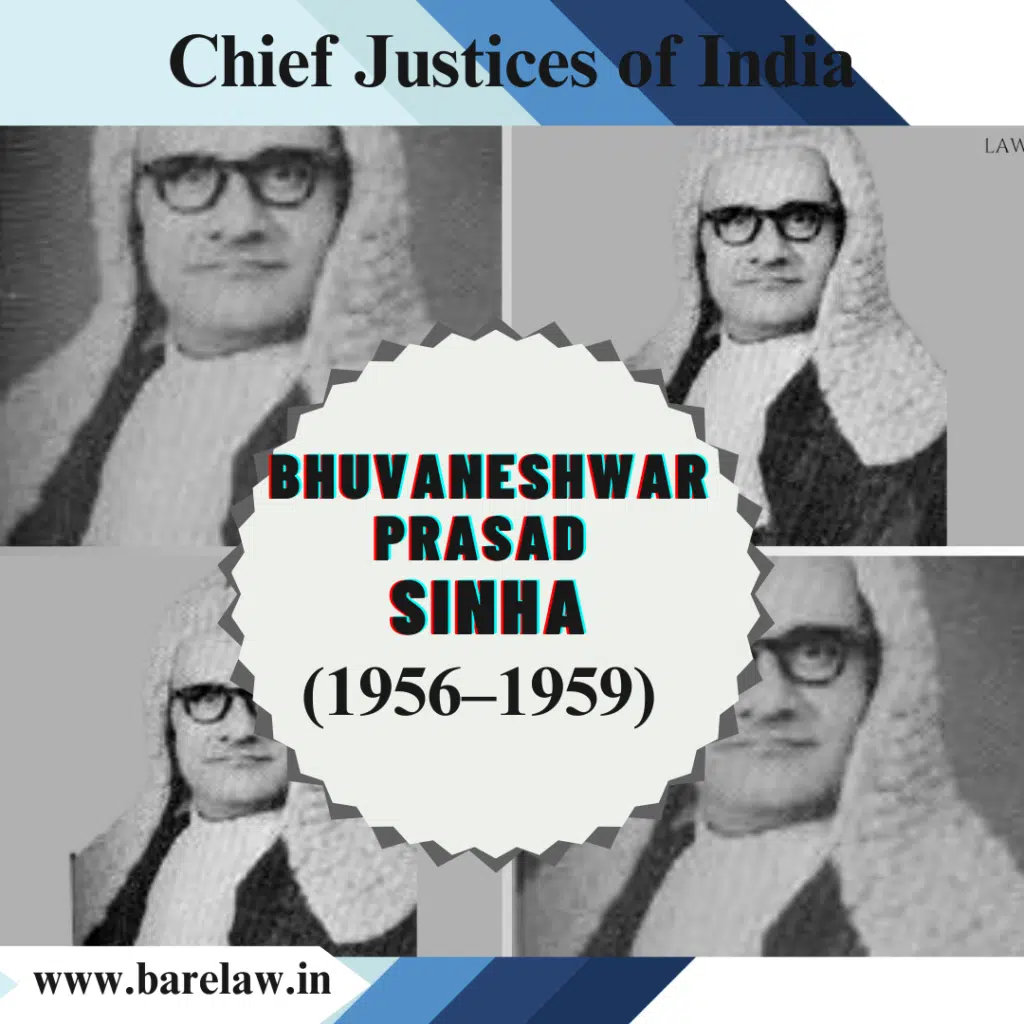
The role of Chief Justice of India is one of paramount importance in the Indian judiciary. It involves not only the administration of justice but also the interpretation of the Constitution, making it a position of immense influence and responsibility. In the annals of India’s legal history, one name that shines brightly is that of Bhuvaneshwar Prasad Sinha, who served as the Chief Justice of India from 1956 to 1959. This article delves into the life and legacy of Chief Justice Bhuvaneshwar Prasad Sinha, a jurist whose contributions continue to reverberate in the Indian legal landscape.
Early Life and Education
Bhuvaneshwar Prasad Sinha was born on October 2, 1895, in the historic city of Varanasi, a place known for its deep-rooted traditions and intellectual heritage. His early years were marked by a keen interest in academics, and he pursued his education with dedication and diligence. He completed his LL.B. from Allahabad University and was called to the bar in 1916. Little did the legal fraternity know that this young man would go on to leave an indelible mark on the Indian judicial system.
A Rising Star in Legal Circles
B.P. Sinha quickly gained recognition for his legal acumen and remarkable understanding of the law. His early legal career was distinguished by his commitment to justice and his ability to navigate complex legal issues. He practiced law in the Allahabad High Court, where he honed his skills and built a reputation as a formidable advocate.
Sinha’s rise through the legal ranks was meteoric. He was appointed as a Judge of the Allahabad High Court in 1937 and went on to become its Chief Justice in 1949. During his tenure at the helm of the Allahabad High Court, he delivered several landmark judgments that showcased his deep understanding of constitutional principles and his unwavering commitment to upholding the rule of law.
A Beacon of Justice as Chief Justice of India
In 1956, Bhuvaneshwar Prasad Sinha assumed the office of the Chief Justice of India, a role that would define his legacy in the Indian judiciary. As the highest-ranking judicial officer in the country, he was tasked with overseeing the functioning of the Supreme Court and ensuring the proper interpretation of the Constitution.
During his tenure as Chief Justice of India, Sinha presided over several crucial cases that had far-reaching implications for the country. One of the most notable cases during his time was the historic Keshavananda Bharati case in 1958. This landmark case dealt with the fundamental question of whether the Parliament could amend the Constitution’s basic structure. Chief Justice Sinha’s judicious wisdom played a pivotal role in the final verdict, which upheld the basic structure doctrine, safeguarding the core principles of the Indian Constitution.
Contributions to Legal Jurisprudence
Chief Justice Bhuvaneshwar Prasad Sinha’s tenure witnessed a significant expansion of legal thought and principles in India. His judgements and legal opinions were characterized by a deep reverence for the Constitution and a commitment to protecting individual rights and freedoms. His legacy includes several key contributions to Indian legal jurisprudence:
- Preservation of Constitutional Integrity: The Keshavananda Bharati case was a watershed moment in Indian legal history, and Sinha’s role in upholding the Constitution’s basic structure doctrine ensured that the fundamental principles of the Constitution remained sacrosanct.
- Protecting Individual Liberties: Sinha consistently advocated for the protection of individual liberties and fundamental rights enshrined in the Constitution. His judgements reinforced the idea that the judiciary serves as a bulwark against arbitrary government actions.
- Judicial Independence: Chief Justice Sinha firmly believed in the concept of judicial independence. He worked tirelessly to uphold the independence of the judiciary, ensuring that it remained a beacon of justice and accountability.
- Promotion of Legal Education: He recognized the importance of legal education in producing competent legal professionals. His efforts contributed to the development of legal education institutions in India.
Legacy and Influence
Chief Justice Bhuvaneshwar Prasad Sinha’s legacy extends far beyond his time on the bench. His commitment to justice, unwavering dedication to the Constitution, and deep understanding of legal principles continue to inspire generations of jurists, lawyers, and legal scholars in India. His judgements are cited and relied upon in countless legal arguments, setting precedents that shape the country’s legal landscape.
Furthermore, Sinha’s emphasis on judicial independence has had a lasting impact on the Indian judiciary. His efforts to safeguard the judiciary from external influence have played a crucial role in maintaining its integrity and ensuring that it remains a bastion of justice.
Conclusion
Bhuvaneshwar Prasad Sinha’s tenure as Chief Justice of India was marked by his unwavering commitment to justice, the Constitution, and the rule of law. His contributions to legal jurisprudence, especially in the context of the Keshavananda Bharati case, have left an indelible mark on the Indian legal landscape. His legacy continues to inspire and guide those who seek justice, and his vision of a robust, independent judiciary remains a cornerstone of the Indian legal system. Chief Justice B.P. Sinha will always be remembered as a legal luminary who played a pivotal role in shaping the course of legal history in India.