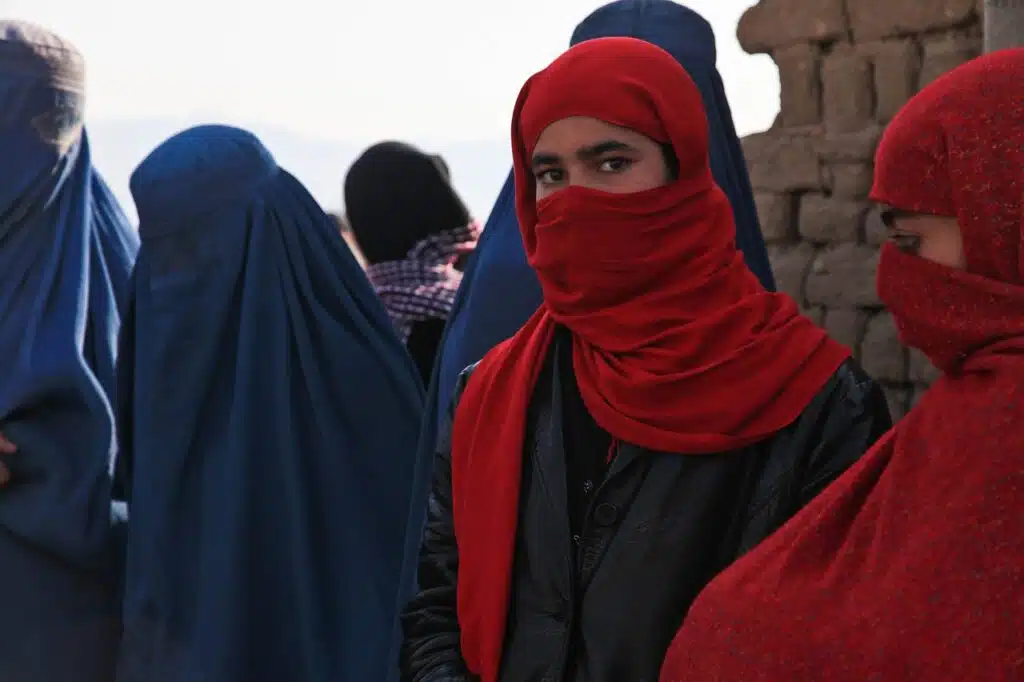
Afghan Women Find Glimmer of Hope in International Efforts to Bring Taliban to Justice for Gender Discrimination
Recent headlines brought a glimmer of hope to the women and girls whose lives under the Taliban have essentially been reduced to prison terms: Canada, Australia, Germany, and the Netherlands said they would seek to take the Taliban to the International Court of Justice (ICJ) for gender discrimination.
Being an Afghan woman, I shudder as I see the Taliban steadily trying to eliminate our voices, one freedom at a time. Since I was a child I have grown up in an Afghanistan where women and girls like me were allowed to work and study, I felt it was my duty to stand up for my fellow Afghan women and girls.
At first, I wanted to struggle for international legal justice at the international court. However, I was quickly discouraged by the documentation that would be needed – documentation that would be rather difficult for a private practitioner to obtain at any one time, let alone when they are mostly restricted to their home. I then had to turn to the task of influencing the general population and wrote an appeal for help. I wrote:
It is remarkable that the ICC has not even fully established the Taliban’s abuses against women and humanity under a wider category. Half of Afghanistan’s population comprises Afghan women and girls who are calling on the ICC as the most powerful international tribunal to investigate all crimes committed against women in Afghanistan and to help them regain their basic rights and fight for the restoration of their rights. They have a natural right to live and work and be active members of the society.
It was one voice in the many that were being raised in Afghanistan and across the globe and, collectively, we forged and sustained a campaign for women’s rights in Afghanistan.
However, the rights activists have endeavored to restore the rights at all levels for the past three years, they have not been able to restore the rights. These constraints prevented the advancement of Afghan women and allowed them to be left out of critical discussions of our nation’s future. The disunity created dilemma for the international organizations on how to offer tangible help and aid.
This year alone, about 120 Afghan women from different countries met in Tirana, Albania, to stand up and plan against the Taliban. This summit which took place only two weeks after the Taliban leader came up with new morality rules prohibiting women’s voices and faces from appearing in public offered a great opportunity for partnership and set the tone for a woman-focused agenda towards lasting peace. Afghan women have felt like the only line of defense since the end of the previous Afghan government in August 2021; Women have used our words as our weapons.
The unity we got at Albania summit has made us more powerful and also got the support of other countries. I was not able to be there myself, but I support all the women leaders who have spoken up for us and for our cause, particularly when the Taliban tries to muzzle women. Hollywood actress Meryl Streep aptly described our plight at a UN General Assembly event: ”Today in Kabul a cat is free than a woman A cat may be on her front porch watching the sun or she may be playing with a squirrel in the park.”
Through their systematic gender apartheid, the Taliban have reduced women to almost the level of objects, therefore, our plight can be likened to that ofanimals. Streep added, “A squirrel has more rights than a girl in Afghanistan today because public parks have been closed to women and girls by the Taliban.” A bird may sing in Kabul but a girl may not do the same in public. This is extraordinary. This is against the natural law.”
On September 25, at the UN General Assembly, Canada, Australia, Germany and the Netherlands said they would refer the Taliban to the ICJ for gender discrimination. This is the first time that countries are using the ICJ to sue another country for gender based discrimination. The legal maneuver is the first of its kind since the Taliban’s return to power and the Afghan government is expected to have a six-month period to respond before the ICJ will hold a hearing, and most likely recommend measures to be taken in the meantime.
The case is being commenced under the Convention on Discrimination against Women (CEDAW) which was adopted by the UN General Assembly in 1979 and entrenched in 1981. This convention came into force in 2003 after Afghanistan signed it.
In my view, both ICC and ICJ have jurisdictional authority over Afghanistan. They can take the Taliban regime to the ICJ and label it as a perpetrator state while the individual Taliban leaders who have directly limited women’s rights or violated them in some way can be taken to ICC.
This lawsuit is a ray of light for Afghan women and girls, and for all the women and girls of the world. It recognizes our pain and fatigue and tells us that the rest of the world is now ready to act in our defence for human rights and social equality. This process, I believe that the more we persist and the unity we have will create positive change and restore the rights of women and girls in Afghanistan.
The author of this paper is an Afghan legal expert whose identity cannot be disclosed at this time for security reasons.